
Define, assess and improve payment infrastructure quality with structured methods
REALSUCC turns payment infrastructure quality, maturity, architecture review and quality control into a structured methodology system, helping organizations identify issues, prioritize improvements, define target states and verify outcomes using consistent standards.
The methodology spans assessment, architecture, software implementation and continuous governance, turning expert judgment into repeatable, evidence-based and verifiable working methods.
Why methodology matters
Complex payment infrastructure should not depend on individual opinion alone. Shared methods, evidence and quality standards create a consistent basis for identifying risk, making trade-offs and validating outcomes.
Consistent judgment
Turn subjective quality judgments into explicit dimensions, evidence and criteria.
Clearer priorities
Separate critical risks, capability gaps and longer-term improvements.
Verifiable delivery
Translate design, implementation and go-live expectations into evidence-based quality gates.
Reusable knowledge
Convert project experience into repeatable methods, checklists and governance mechanisms.
How the methodology works as one system
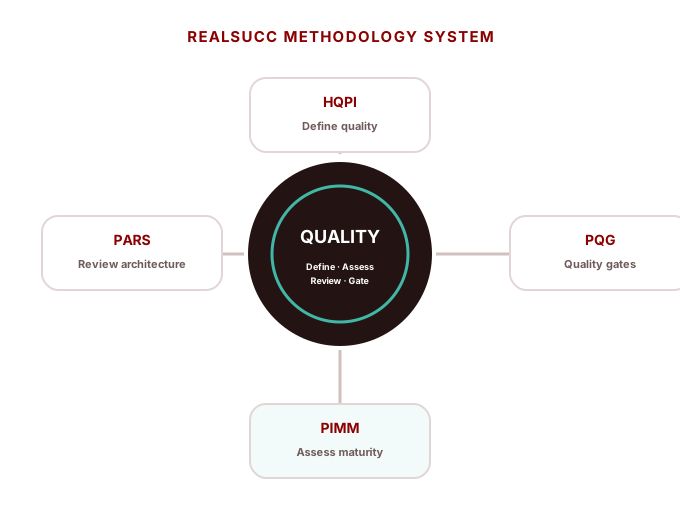
HQPI defines quality, PIMM assesses maturity, PARS reviews architecture, and PQG controls delivery quality. Together they form a continuous improvement loop.
HQPI establishes a shared quality language and target state.
PIMM identifies the current stage and capability gaps.
PARS tests whether architecture can support quality and growth.
PQG verifies critical quality conditions across delivery stages.
Operational evidence and reassessment drive continuous governance.
Define Quality → Assess Maturity → Review Architecture → Control Delivery → Improve Continuously
Define quality
HQPI establishes a shared quality language and target.
Assess maturity
PIMM identifies the current stage and capability gaps.
Review architecture
PARS examines the key architecture and control foundations.
Control delivery
PQG verifies required quality conditions at critical stages.
Improve continuously
Operational evidence, metrics and reassessment drive ongoing governance.
How methodology is used in real engagements
Assessment & diagnosis
HQPI + PIMM
Identify quality gaps, maturity and priority improvements.
Architecture & solution design
HQPI + PARS
Use quality targets and architecture standards to shape the target state.
Software & implementation
PQG
Establish verifiable quality gates across design, build, test and go-live.
Continuous governance
HQPI + PIMM + PQG
Use metrics, reassessment and quality gates to drive continuous improvement.
From methodology to tools to action
Methodology establishes judgment standards. Tools turn standards into self-assessments and checklists. Professional Assessment combines those standards with evidence to produce findings and an improvement roadmap.
Maturity self-assessment
Use PIMM to quickly estimate the current maturity stage.
Architecture review checklist
Use PARS to inspect critical architecture domains.
Payment quality gate checklist
Use PQG to verify readiness at key stages.
Professional assessment
Combine HQPI, PIMM, PARS and project evidence into structured findings.
Assess your payment infrastructure with a consistent method
When the scope is complex, root causes are unclear or multiple teams are involved, start with a structured Assessment to establish facts, quality judgments and improvement priorities.