
Payment Operating System Core
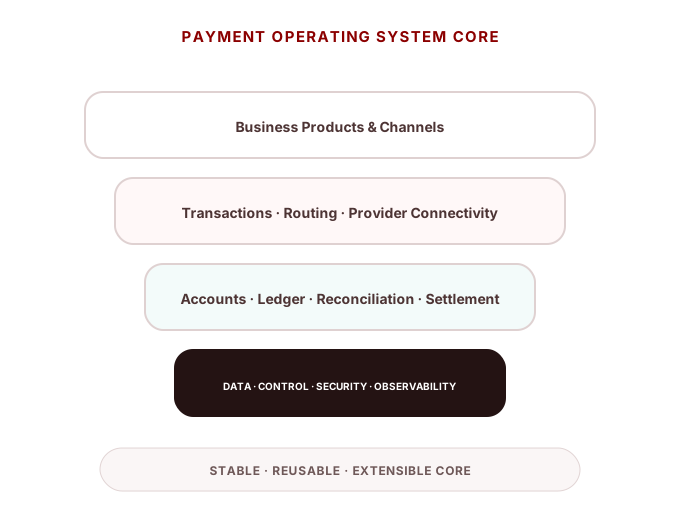
Unify transaction processing, accounts, foundational ledgering, routing, reconciliation, settlement, exception handling and payment-provider connectivity in one stable, reusable core platform.
Consolidate capabilities repeatedly rebuilt across wallets, card programs, remittance and other payment products, while creating a durable foundation for new products, markets and transaction growth.
Product scope: This is deployable software for a defined payment capability, not a complete advisory or business solution. It can be combined with assessment, architecture and implementation services when needed.
When core payment capabilities are being rebuilt repeatedly
Repeated core capability build
Wallets, issuing, remittance and other payment products often rebuild transaction, account, ledger and exception logic independently, duplicating engineering effort.
Provider logic leaks into product systems
Bank and provider interfaces, statuses and error models become embedded in business code, making every new or replacement provider expensive to integrate.
Inconsistent data and state models
Products use different transaction states, account logic and funds models, making cross-product operations, reconciliation and analytics increasingly difficult.
Expansion gets slower
Every new product, market, currency or payment method requires more foundational work, increasing delivery time and maintenance cost.
Standardize the high-reuse payment core
The Payment Operating System Core turns payment capabilities that demand high reuse and consistency into standard platform services.
Transaction Processing
Manage payment requests, transaction lifecycles, state transitions and outcomes with a consistent foundation for payments, refunds, reversals and related operations.
Accounts & Balances
Manage accounts, balances, available funds, held funds and balance movements for wallets, issuing, remittance and other payment products.
Foundational Business Ledger
Convert transactions, fees, refunds, adjustments and settlement events into consistent, traceable foundational ledger records.
Routing & Provider Connectivity
Connect banks, PSPs, acquirers and payment networks through a common connectivity framework while isolating external differences from core business logic.
Reconciliation
Bring together transaction, ledger, provider, bank and settlement data, identify breaks through standard matching rules and route them into exception workflows.
Clearing & Settlement
Manage fees, netting, batches and settlement states as a consistent foundation for clearing and settlement between business parties, providers and funding accounts.
Exceptions & Recovery
Standardize detection, compensation and recovery for timeouts, failures, duplicates, unknown states, reversals and other transaction exceptions.
APIs, Events & Observability
Expose standard APIs, webhooks and events to business systems while providing logs, metrics and critical runtime visibility.
Product boundary: the Payment Operating System Core provides foundational routing and business-ledger capabilities. Advanced multi-provider orchestration, policy routing and resilience can be extended through Payment Orchestration; full subledger, accounting rules, trial balance, general-ledger mapping and financial controls can be extended through the Payment Accounting Module.
A shared execution core for payment products
Reference flow: Channel / Product → Unified Payment API → Transaction & State Engine → Account / Basic Ledger → Provider Connectors → Reconciliation & Settlement.
Business Applications
Card issuing & expense management, cross-border remittance, digital wallets and other payment products.
Payment Operating System Core
Transaction, accounts, foundational ledger, routing, reconciliation, settlement, exceptions and API / event capabilities.
Payment Connectivity
Banks, PSPs, acquirers, payment networks and other external services.
Core objects that keep payment behavior consistent
Payment Order
A normalized instruction representing what should be paid, collected, refunded or adjusted.
Transaction
The execution record that captures lifecycle, amount, currency, status and provider references.
Account
The business account or balance container to which payment activity is attributed.
Balance & Hold
Available, pending or reserved value states used to control how funds can move.
Provider & Route
The external payment capability selected or invoked to execute the transaction.
Settlement Record
The downstream record that links transaction outcomes to reconciliation and settlement facts.
Where the platform fits
New payment platform build
Provide a common core for new wallet, issuing, remittance or other payment products.
Multi-product platform consolidation
Gradually standardize transaction, account, ledger and connectivity capabilities duplicated across multiple products.
Multi-provider connectivity
Reduce the impact of bank and payment-provider differences on core systems through a common connectivity framework.
Multi-market and multi-currency expansion
Reuse core capabilities as markets, currencies and payment methods expand instead of rebuilding the foundation.
Legacy payment modernization
Gradually extract or replace fragmented core payment capabilities while existing businesses continue to operate.
Fit the core into your existing payment stack
Integrate through synchronous APIs, asynchronous events and provider connectors while keeping the core independent from channel-specific implementations.
API First
Use standard APIs, webhooks and event interfaces to work with existing business applications and surrounding services.
Modular Integration
Introduce core capabilities incrementally based on the current architecture without requiring a one-time replacement of every system.
Ecosystem Connectivity
Integrate with banks, PSPs, acquirers, risk, finance and other surrounding systems, with deployment designed around the client architecture and security requirements.
API
Synchronous commands and queries for payment initiation, status and account interactions.
Events & Webhooks
Asynchronous state changes for authorization, clearing, refunds, failures and settlement.
Connector Layer
Standard adapters isolate provider-specific formats, credentials and operational behavior.
Deployment Boundary
Can be introduced as a shared platform service without forcing immediate replacement of every existing system.
Designed for payment infrastructure
Payment-native design
Core models are built around transactions, accounts, funds, ledgering, settlement and exceptions rather than adapting a generic workflow product to payments.
Funds accuracy first
Ledgering, balances, reconciliation and settlement are considered from the transaction and account design stage so funds states remain continuously verifiable.
Modular and composable
Capabilities can be introduced incrementally into an existing architecture or provide one shared foundation for multiple business applications.
Designed for production
Transaction states, idempotency, recovery, reconciliation, monitoring and operational controls are designed into the product core from the start.
From design to implementation
REALSUCC can combine architecture, software, integration, migration and continuous governance to move the product into a real production environment.
Build a unified payment core
If you are building a new payment platform, or existing wallet, issuing, remittance and other products are repeatedly rebuilding transaction, account, ledger and provider capabilities, explore how the Payment Operating System Core can fit into your existing stack.