
Settlement Discrepancies
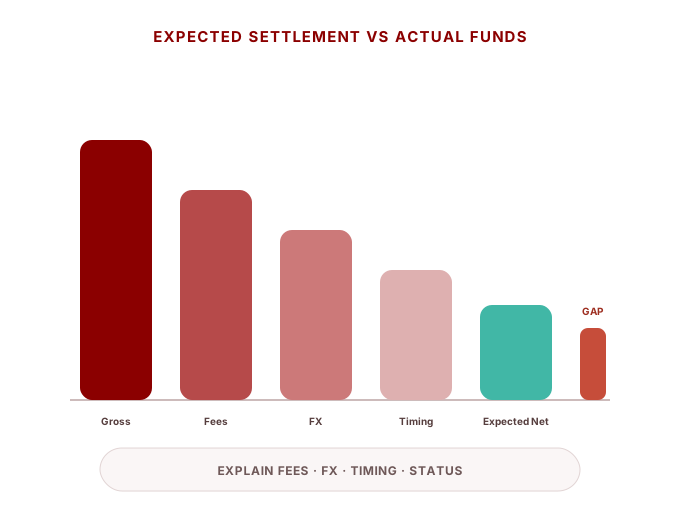
A successful payment does not mean funds have settled correctly. Differences in expected settlement, bank receipt, fees, FX, timing or settlement status can create real financial exposure.
What you may be seeing
- Expected settlement differs from PSP settlement reports or actual bank receipts.
- Fees, FX, reserves or netting are difficult to explain.
- Settlement is delayed but systems cannot clearly show where funds are.
- Refunds, chargebacks and cross-period events change later settlement outcomes.
- Operations and Finance manually chase settlement batches and bank receipts.
Why it happens
Transactions do not map reliably to settlement batches.
Fee, FX, reserve and reversal rules are fragmented.
Receivable, payable, pending and settled states are not unified.
Provider calendars and cut-offs are not systemized.
Net settlement cannot be reconstructed from detailed components.
Settlement exceptions rely on email and manual follow-up.
Where the issue usually sits
Business & Funds
Where the business outcome and money state become inconsistent.
Systems & Data
Where identifiers, state, rules or data diverge across systems.
External Dependencies
Where providers, banks or networks add different semantics.
Controls & Operations
Where exceptions, ownership and evidence fail to close the loop.
What happens if it persists
- Funds risk and customer impact can grow before the issue is visible.
- Manual investigation and operational cost increase over time.
- Close, audit and management reporting become harder to trust.
- Scale amplifies the underlying structural problem.
When settlement differences begin to affect cash and financial outcomes
If settlement amounts, fees, FX or timing differences repeatedly affect cash positions, customer balances or finance close, the issue should be treated as an end-to-end settlement control problem rather than a periodic adjustment.
- Can the team explain the issue without relying on one key person?
- Can every affected transaction or funds movement be traced end to end?
- Are exceptions classified, owned and closed with evidence?
- Do rules work consistently across providers and markets?
- Is the same issue recurring despite repeated manual fixes?
How settlement differences escalate from timing noise to funds risk
Settlement issues become structural when the organization can no longer distinguish timing, fees, FX and true funds differences with a repeatable evidence chain.
Isolated timing or fee variance
A small difference is explained by a known settlement window, fee, FX rate or cut-off and clears as expected.
Recurring provider-level mismatch
The same settlement differences reappear by provider, product, currency or market and require manual explanation.
Multi-provider and multi-currency allocation becomes manual
Teams manually allocate funds, fees, FX and settlement amounts across providers, currencies or legal entities.
Settlement affects liquidity and financial reporting
Unresolved positions begin to distort receivables, payables, cash visibility, close or treasury decisions.
Final settlement position is not authoritative
The organization cannot confidently state what has been earned, paid, received, held, in transit or still due.
Treat settlement as a structural funds-control issue when recurring differences require manual allocation across providers or currencies, or when unresolved positions affect liquidity, close, receivables or payables.
How to address it
Structure the symptom
Separate visible symptoms from underlying causes.
Build a fact baseline
Use transaction, funds, system and operational evidence.
Fix the model, not only the data
Correct structural rules before cleaning historical records.
Close the control loop
Give each exception ownership, action, verification and closure.
Measure recurrence
Use repeated issues to drive product, architecture and operational improvement.
Move from the problem to the right solution
Common questions
Is the visible symptom always the root cause?
No. Payment problems often surface in reconciliation, balances or operations while the underlying cause sits in state, ledger, data or architecture.
Should we fix historical data first?
Usually establish the model and control baseline first, then remediate historical data without recreating the same issue.
Where should an investigation start?
Start with evidence: transaction lifecycle, funds movement, ledger entries, provider records, operational workflow and recent incidents.
Start from the real problem
Structure the symptom, root cause, impact and current controls before choosing the remediation path.