
Is our payment architecture truly fit for long-term operation and growth?
PARS is an architecture review standard designed around payment-specific requirements. It does not judge architecture by whether it uses fashionable technology, but by whether it can sustain funds accuracy, transaction reliability, production operations and business growth.
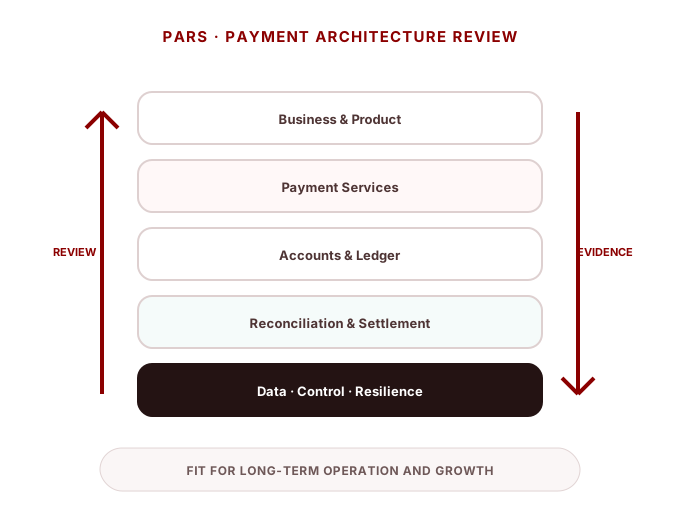
Why payment architecture needs independent review
Architecture weaknesses often surface as balance breaks, uncertain transaction states, operational complexity, provider coupling and risky change—not just technical incidents. PARS reviews these structural foundations consistently.
Core framework
Business capabilities & domains
Are business objects, capability boundaries, ownership and data responsibility clear?
Transactions & state
Are lifecycle, terminal states, retry, compensation, reversals and delayed events explicit?
Accounts & funds
Can account hierarchy, balance states, holds, in-transit funds and movements be explained?
Ledger
Do events, entries, fees and funds movements form a consistent accounting model?
API, events & data
Are interfaces, events, idempotency, versions and core data models controlled?
External payment integration
Are differences across banks, PSPs, acquirers and providers properly isolated?
Reliability & recovery
Do timeout, retry, circuit breaking, recovery, DR and data repair match business risk?
Security, access & observability
Do identity, access, sensitive data, audit, monitoring and alerting form a complete operating foundation?
How PARS works
Understand business and risk
Clarify scope, funds flows, critical dependencies and target state.
Collect architecture evidence
Use diagrams, interfaces, data models, operating metrics and incident records.
Review by domain
Identify structural gaps, risks and design trade-offs.
Define target recommendations
Provide target architecture direction, key decisions and implementation priorities.
Typical outputs
Architecture issue register
Key design gaps with risk levels.
Target architecture recommendations
What to retain, decouple, redesign or add.
Key design decisions
Traceable architecture decisions and principles.
Modernization roadmap
A phased implementation path from current to target state.
The four methods are designed to work together rather than as isolated frameworks.
Review architecture using payment business facts
Use PARS to identify structural risks and define a target architecture path when systems are scaling, modernizing or entering new markets.