
Payment Accounting Module
Turn payment transactions, fees, refunds, chargebacks, FX, adjustments and settlement events into consistent, traceable and auditable accounting records that provide a trusted financial foundation for balances, reconciliation and financial accounting.
Acts as the payment subledger layer between payment business facts and the enterprise general ledger, helping payment institutions and complex payment platforms standardize accounting rules, measurement logic and fund states.
The Payment Accounting Module does not replace the enterprise general ledger. It records and explains the financial and accounting facts of the payment business itself.
Product scope: This is deployable software for a defined payment capability, not a complete advisory or business solution. It can be combined with assessment, architecture and implementation services when needed.
When payment events no longer translate cleanly into accounting facts
Business accounting is fragmented
Transactions, balances, fees, refunds, chargebacks and settlement are often handled by different modules without a single payment accounting fact base.
Balances are difficult to explain
A current balance may be visible, but its formation can be difficult to reconstruct from historical business events and accounting records.
Payment operations and financial accounting are disconnected
Payment systems focus on transaction and fund states while finance focuses on accounts and periods; without stable mapping rules, manual transformation and adjustment become common.
Adjustments, close and audit rely on manual work
Manual journals, historical breaks and inconsistent accounting treatments increase the complexity of closing, audit and fund traceability.
Convert payment events into trusted business accounting
Start from payment business events and use rules, journals, subledgers and controls to create a verifiable payment accounting layer.
Business Events & Accounting Rules
Map payments, refunds, chargebacks, fees, FX, settlement and other payment events to standardized accounting rules.
Double-entry Journals
Record fund movements with complete debit and credit relationships so business events and accounting relationships remain reconcilable.
Payment Subledger
Maintain traceable payment subledgers by customer, merchant, product, legal entity, currency or other business dimension.
Multi-currency Accounting
Record transaction, book and settlement currencies and their conversion relationships for consistent cross-currency accounting.
Fees & FX
Record transaction fees, service charges, FX results and other financial impacts separately from principal amounts.
Trial Balance
Validate debit-credit balance, account balances and critical accounting relationships to surface accounting exceptions early.
General Ledger Mapping
Map payment subledger results to enterprise chart-of-accounts and general-ledger structures through standardized rules and interfaces.
Adjustments, Close & Audit Controls
Apply reason, access, approval and audit controls to manual adjustments, daily close, period close and accounting corrections.
Turn business events into a controlled payment subledger
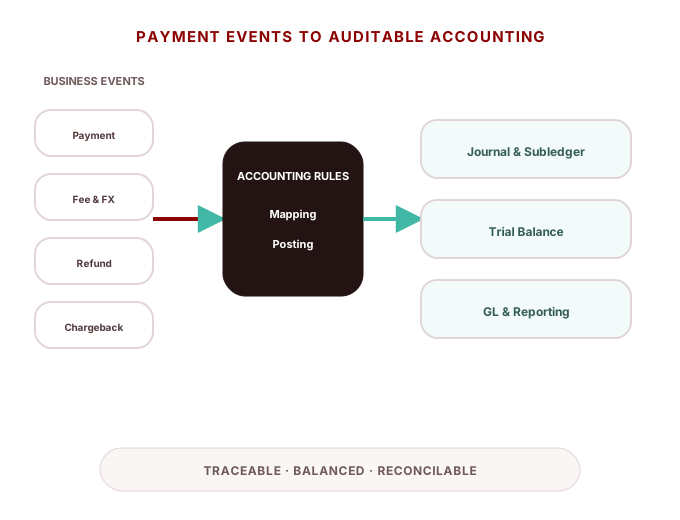
Reference flow: Business Event → Accounting Rule → Double-entry Journal → Payment Subledger → Trial Balance → Reconciliation / Settlement / GL Output.
Payment Business Events
Receive explicit payment, refund, fee, FX, chargeback, adjustment and settlement events.
Accounting Rules & Journals
Generate balanced journal entries according to configured accounting rules while preserving event-to-journal traceability.
Payment Subledger & Trial Balance
Create queryable, traceable business subledgers and continuously validate debit-credit and balance relationships.
Reconciliation, Settlement & Finance Output
Provide consistent accounting results to reconciliation, settlement, enterprise GL and financial reporting processes.
Core objects that make payment accounting reconstructible
Business Event
The source payment event that creates an accounting consequence.
Accounting Rule
A deterministic mapping from event type and context to debit and credit treatment.
Journal Entry
The balanced accounting record generated from the business event.
Subledger Account
The detailed account used to explain balances by customer, product, entity, currency or other business dimension.
Balance Snapshot
A controlled view of account position at a point in time that remains reconstructible from journals.
GL Mapping
The mapping layer that aggregates payment subledger facts into enterprise accounting accounts.
Where it fits
Payment Accounts & Digital Wallets
Create consistent business accounting for balances, funding, transfers, withdrawals, fees and other fund movements.
Card Issuing & Business Spend
Record funding, budgets, card spend, refunds, fees and settlement across the spend lifecycle.
Cross-border Payments & Remittance
Support payment accounting for multi-currency transactions, FX, fees, payouts and settlement.
Multi-provider Payment Platforms
Apply one accounting treatment to transactions, fees and settlement results from multiple payment providers.
Accounting Modernization
Move gradually from fragmented databases, manual journals or legacy systems toward a standardized payment subledger.
Designed for payment fund accuracy
Business-event-driven Accounting
Every accounting record originates from an explicit, traceable payment business event.
Debit and Credit Must Balance
Every fund movement forms a complete and verifiable accounting relationship.
Balances Must Be Reconstructable
Any point-in-time balance should be recalculable and verifiable from historical business events and accounting records.
Manual Adjustments Must Be Auditable
Manual journals, corrections and reversals require clear reasons, access control, approval and complete records.
Clear Boundary Between Subledger and GL
The payment accounting layer records payment business facts accurately before standardized mapping into enterprise financial accounting.
Product relationship: the Payment Operating System Core produces and processes standardized transaction and fund events; the Payment Accounting Module converts those events into complete payment accounting, double-entry journals and business subledgers. The products can be used independently or together.
Connect business systems, reconciliation, settlement and enterprise finance
Connect operational payment systems to finance without turning the enterprise GL into the source of payment truth.
Business Event & API Integration
Receive standard business events from the Payment Operating System Core, wallets, card platforms, remittance systems and other business systems.
Reconciliation & Settlement Collaboration
Share a consistent accounting fact base with reconciliation, settlement and treasury operations to reduce cross-system interpretation gaps.
Finance System Connectivity
Connect to enterprise general ledger, ERP or other finance systems through standardized mappings and interfaces.
Progressive Adoption
Start with selected products, businesses or legal entities without requiring an immediate replacement of the existing finance stack.
Event Intake
Consume normalized events from core payment, wallet, card, remittance or settlement systems.
Rule Engine
Apply versioned accounting logic to generate repeatable journal treatment.
Reconciliation Interface
Expose ledger facts to reconciliation and settlement controls.
Finance Output
Publish controlled mappings or journals to ERP and enterprise GL systems.
Build a trusted payment accounting foundation
If balances, fees, refunds, settlement and financial accounting do not share a consistent fact base today, the Payment Accounting Module can establish standardized payment subledgers and accounting rules.