
Payment Architecture & Modernization
Build payment architecture for the business you need next, not around the constraints of yesterday’s systems. REALSUCC helps clients plan new payment platforms and modernize existing systems through staged governance, refactoring, migration and controlled evolution.
Page scope: This is an end-to-end solution for a business and infrastructure problem, not a single software product. An engagement may combine advisory, architecture, software, implementation and governance.
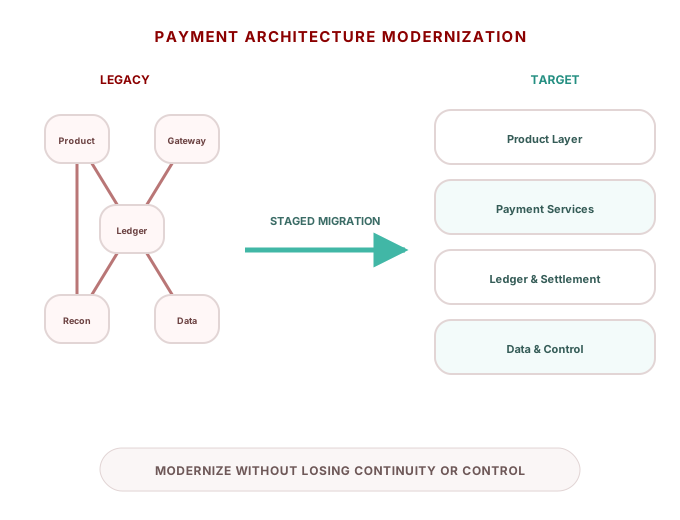
When architecture modernization is needed
New products, markets or channels take longer to launch because one change affects multiple systems and workflows.
Transaction, account, ledger and business-object boundaries are unclear, creating duplicate logic, inconsistent data and growing exceptions.
Critical knowledge depends on a small number of people while testing, release and change risk continue to increase.
Each new currency, entity, payment provider or market requires repeated integration and significant project-specific development.
The organization knows major refactoring is needed but lacks a staged path that can control business and migration risk.
The current platform no longer meets reliability, performance, security, compliance or future transaction-scale requirements.
Modernization scope
Payment architecture modernization is not simply service decomposition or a technology-stack replacement. It rebuilds a structure that can evolve over time across business capabilities, funds and ledger, transaction processing, data, integration, reliability, security and operations.
Business domains & capability boundaries
Clarify business domains, ownership, reusable capabilities and responsibilities between products and core platforms.
Accounts, ledger & funds model
Define accounts, balances, ledger responsibilities, money movement and settlement relationships.
Transactions & state model
Design transaction lifecycles, states, idempotency, retries, reversals, compensation and recovery.
Application & service architecture
Define service boundaries, dependencies, modularization and the target application structure.
Data, APIs & event architecture
Standardize core payment data, internal and external APIs, events and integration patterns.
Reliability & recovery
Embed failure isolation, resilience, retry, compensation, recovery and capacity principles.
Security, access & audit controls
Build identity, permissions, sensitive-data handling, audit and critical business controls into the architecture.
Observability, deployment & runtime
Design logging, metrics, tracing, release, runtime and operational visibility as part of the platform.
Modernization principles & methods
Business capabilities first
Architecture starts from business models, operating requirements and future growth rather than from technology components.
Funds and ledger accuracy first
Core logic involving accounts, balances, ledger and settlement must remain explainable and verifiable throughout change.
Standardize the core, configure the edge
Standardize reusable payment capabilities while placing market, provider and customer differences in rules, configuration and adapters.
Evolve progressively
Prefer staged replacement, parallel validation and capability migration over high-risk one-time rewrites.
Design reliability in
Idempotency, retry, compensation, recovery, monitoring and exception handling are architecture responsibilities, not afterthoughts.
Make quality verifiable
Translate architecture principles into engineering standards, tests, release criteria and runtime measures.
From big-bang rewrite to controlled evolution
For a live payment platform, modernization should rarely mean replacing everything at once. The safer objective is to protect money accuracy, transaction continuity and business operations while decomposing change into controlled, verifiable and reversible stages.
Establish the current-state baseline
Map systems, domains, dependencies, data, money flows and material risks.
Define the target architecture
Set future capability boundaries, platform structure, service relationships and quality objectives.
Select migration units
Break modernization into business capabilities, services or data domains that can move independently.
Build and evolve in stages
Run new and legacy capabilities in controlled coexistence while migrating progressively.
Validate and cut over
Use data comparison, transaction validation, reconciliation, rollback and quality gates to control release risk.
Retire legacy capabilities
Remove duplicate logic and old components only after production stability and evidence are established.
Key deliverables
Current architecture & issue baseline
A structured view of systems, domains, dependencies, data and material architectural risks.
Target architecture blueprint
Business, application, service, data, integration and infrastructure target architecture.
Payment domain & data models
Clear boundaries and relationships for accounts, ledger, transactions, settlement and other core domains.
Architecture principles & engineering standards
Reliability, idempotency, recovery, security, auditability and observability standards.
Integration & interface design
Internal services, external payment providers, APIs and event interaction patterns.
Migration & cutover plan
Data migration, parallel run, validation, cutover and rollback strategy.
Phased implementation roadmap
Priorities, dependencies, milestones and sequencing for controlled execution.
Quality & acceptance baseline
Measurable requirements for design, testing, release and production readiness.
What architecture modernization should change
Reduce business and money risk by replacing high-risk big-bang rewrites with staged evolution and migration.
Lower system coupling so product and business changes can be delivered faster and more independently.
Make transaction, account and ledger states clearer, explainable and verifiable.
Create extensible foundations for new markets, products, payment providers and transaction growth.
Translate architecture principles into executable engineering and quality standards across development, testing, release and operations.
Reduce dependency on critical individuals and lower long-term maintenance cost.
Improve fault isolation, recovery capability and operational resilience.
Related solutions
Payment Infrastructure & System Assessment
Systematically identify the current state, material risks and improvement priorities before a modernization program begins.
Ledger, Reconciliation & Settlement
Build or remediate core money accuracy, ledger, reconciliation and settlement capabilities.
Payment Operations & Controls
Strengthen exception handling, provider management, funds operations and day-to-day control mechanisms.
Plan the next stage of your payment architecture
If the current payment platform is starting to constrain product delivery, market expansion or system reliability, begin with an architecture review to clarify the target state, priorities and a controlled path of evolution.