
What stage is our payment infrastructure at today?
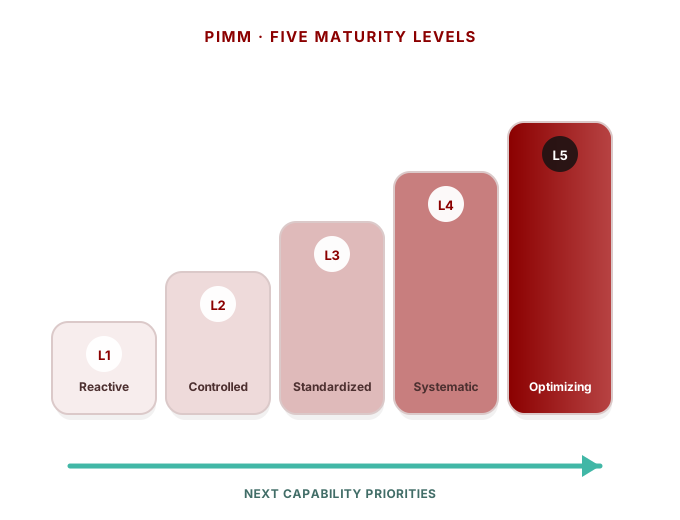
PIMM uses five maturity levels to identify the current stage of payment infrastructure and connect the next capability priorities to business scale, risk and growth stage.
Why a maturity model is needed
Organizations do not need to reach the same “best architecture” at the same time. The value of maturity assessment is to determine whether current capabilities fit the business and what should be improved next.
Core framework
L1 — Runnable
Core flows work, but operations depend heavily on people, manual tasks and temporary workarounds.
L2 — Accurate & reliable
Critical transactions, balances, ledger, reconciliation and exception outcomes can be verified.
L3 — Safe & controlled
Access, risk, change, incidents and operations have systematic controls and auditability.
L4 — Scalable
Architecture, processes and organization can support growth in volume, products, markets and providers.
L5 — Governable & sustainable
Quality is measurable; metrics, quality gates, versions, technical debt and continuous improvement become organizational capabilities.
How PIMM is used
Understand the business stage
Clarify products, scale, markets, risks and future goals.
Assess maturity
Evaluate quality, controls, architecture, operations and governance.
Identify critical gaps
Find the capabilities preventing progression to the next stage.
Build a staged roadmap
Translate gaps into 90-day, half-year or annual capability priorities.
Typical uses and outputs
Maturity assessment
Evidence-based view of the current maturity level.
Capability gap map
Capabilities required to progress to the next stage.
Investment priorities
Prioritization across architecture, software, operations and governance.
Stage roadmap
A practical improvement plan aligned to business growth.
The four methods are designed to work together rather than as isolated frameworks.
Know where you are before deciding what to build next
Establish a maturity baseline with PIMM and turn capability gaps into explicit improvement priorities.