
Ledger, Reconciliation & Settlement
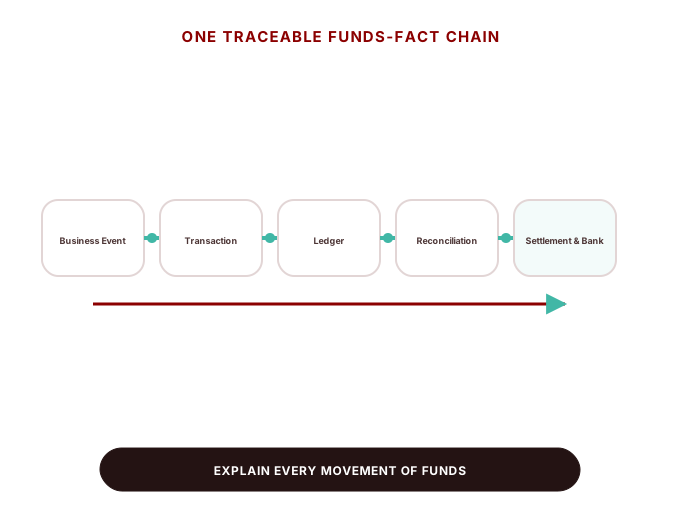
Every movement of funds must be explainable. REALSUCC helps organizations connect transactions, accounts, balances, fees, refunds, chargebacks, FX, settlement and bank funds into a unified, reconcilable and traceable funds-fact system. From business events to ledger entries and external settlement results, critical funds states can be continuously verified.
Page scope: This is an end-to-end solution for a business and infrastructure problem, not a single software product. An engagement may combine advisory, architecture, software, implementation and governance.
When ledger, reconciliation & settlement need stronger governance
Customer balances, internal ledgers, payment-provider records and bank funds do not remain consistently aligned.
Transactions, refunds, chargebacks, fees and settlement are maintained across different systems without one reliable funds fact base.
Reconciliation relies heavily on spreadsheets and manual expertise, while unmatched breaks continue to accumulate.
Settlement files, bank statements and internal ledgers describe the same funds using different amounts, timing or states.
Historical differences lack a complete evidence chain, increasing month-end close, finance-review and audit effort.
As currencies, entities, products and payment providers expand, the existing ledger and reconciliation model no longer scales with complexity.
What ledger, reconciliation & settlement include
These are not isolated finance activities. Together they form the control system that verifies how payment events become balances, ledger facts, clearing outcomes and final movement of funds.
Business ledger & subledgers
Translate transactions, balances, fees, refunds, chargebacks and settlement outcomes into consistent business-ledger facts.
Accounts & balance controls
Manage available, held, in-transit and other balance states with clear ownership and movement logic.
Automated reconciliation
Match transactions, ledgers, payment providers, bank data and settlement records and identify differences systematically.
Clearing & settlement
Manage allocation, netting, fees, FX, settlement batches and final movement of funds.
Break & exception handling
Create closed-loop handling for missing, duplicate, amount, timing, fee, FX and settlement differences.
Daily/monthly close & audit support
Validate ledger completeness, trial balances, unresolved breaks, closing conditions and audit evidence.
Build scope
REALSUCC connects business events, funds objects, ledger rules, reconciliation logic and settlement controls so the same funds can be explained consistently across systems.
Funds & ledger object model
Define accounts, balances, business events, ledger entries, funds states and their relationships.
Business subledger & GL mapping
Define how payment-business facts are represented in subledgers and mapped into financial accounting.
Reconciliation data & matching model
Define sources, identifiers, timing, matching logic, tolerances and reconciliation layers.
Clearing, fees, FX & settlement model
Define allocation, netting, charges, currency conversion, settlement cycles and settlement status.
Break taxonomy & exception handling
Define difference categories, ownership, workflow, adjustment, evidence and closure standards.
Automated matching, tolerance & review
Automate high-confidence matching while routing judgment-dependent differences into controlled review.
Multi-layer reconciliation controls
Define reconciliation among transactions, subledgers, providers, settlement files, banks and financial accounting.
Close, audit & operating controls
Define daily/monthly close criteria, audit trails, manual-adjustment controls and management metrics.
Design principles & methods
Create one funds fact base
The same movement of funds must remain linkable across transactions, ledgers, reconciliation and settlement.
Let business events drive ledger changes
Ledger movements should originate from explicit business events rather than downstream manual repair.
Make balances verifiable
Any balance should be explainable by its source, movement history and current state.
Treat reconciliation as a control
Reconciliation continuously verifies funds facts across systems; it is not merely a month-end reporting task.
Close every break
Each difference needs classification, ownership, action, validation and documented closure.
Close books with evidence
Daily close, month-end close and audit should rely on complete and traceable transaction, ledger and settlement evidence.
Create a unified funds fact base
Systems may store different data structures, but they must still answer the same questions about every material movement of funds.
Whose money is it?
Identify customer, merchant, platform, provider or other ownership and obligation relationships.
Why did it change?
Link each movement to a transaction, refund, fee, FX, adjustment, chargeback or settlement event.
Where is it now?
Identify the relevant internal account, bank, payment provider or funds-in-transit position.
What state is it in?
Distinguish available, held, pending settlement, in transit, settled or exceptional funds.
Why is this the amount?
Explain principal, fees, FX, netting and manual adjustments.
Was it completed correctly?
Verify the final outcome through ledger, reconciliation, settlement and bank evidence.
Build a stable reconciliation control loop
Reconciliation is more than matching records. It standardizes data, identifies breaks, assigns action and verifies that the funds facts return to a consistent state.
Prepare data
Collect transaction, ledger, payment-provider, settlement and bank data from authoritative sources.
Standardize
Normalize identifiers, currency, amount, timestamps, statuses and business semantics.
Match automatically
Apply identifiers, amount, time-window and business rules to reconcile high-confidence records.
Identify breaks
Detect missing, duplicate, amount, timing, fee, FX, status and settlement differences.
Handle exceptions
Assign responsibility and perform correction, follow-up, adjustment or provider escalation under control.
Validate & close
Confirm that ledger and funds states are again consistent and evidence is retained.
Analyze trends & root causes
Use recurring breaks to improve upstream data, system logic, provider quality and operating controls.
Make clearing, settlement & close evidence-based
Settlement should not end with generating a file. Clearing, fees, FX, netting, settlement execution, bank confirmation and close conditions should form one verified chain.
Clearing rules
Allocate funds, fees and obligations across participants, products, entities and currencies.
Netting
Calculate payable and receivable positions by batch, account, entity or provider.
Fees & FX
Separate transaction fees, service charges, spreads and FX impact from principal.
Settlement batches
Manage cycles, cut-offs, batch status, files and execution dependencies.
Funds confirmation
Verify expected receivables/payables against actual provider and bank movements.
Daily & month-end close
Confirm unresolved transactions, unmatched breaks, exceptional balances and incomplete settlements before closing.
Audit evidence
Retain source data, matching logic, manual adjustments, approvals and settlement proof.
From manual reconciliation to automated governance
Automation should handle deterministic work and concentrate human review on differences that truly require judgment.
Unify data
Define authoritative sources, identifiers, fields and business semantics.
Standardize rules
Define matching, tolerances, break categories, ownership and handling standards.
Automate matching
Automate high-confidence reconciliation and posting where the evidence is deterministic.
Systemize exception workflows
Route unresolved differences into controlled review, approval and closure workflows.
Improve continuously
Use break trends and root-cause data to improve upstream quality, matching rates and control effectiveness.
Final deliverables
Funds & ledger baseline
Document accounts, ledgers, funds flows, source systems and critical accuracy gaps.
Funds & ledger object model
Define accounts, balances, business events, ledger entries and funds-state relationships.
Business subledger & accounting mapping
Define how payment-business facts map into financial accounting without forcing accounting systems to carry payment logic.
Reconciliation architecture & rules
Define data sources, matching logic, tolerances, exception handling and multi-layer reconciliation controls.
Clearing & settlement model
Define clearing, fees, FX, netting, settlement batches, funds execution and confirmation.
Break & exception framework
Define taxonomy, ownership, workflow, adjustment controls, evidence and closure criteria.
Daily/month-end close & audit controls
Define closing conditions, completeness checks, manual-adjustment controls and audit evidence.
Software & implementation roadmap
Define priorities for ledger, reconciliation, settlement and accounting-system enablement and automation.
What stronger ledger, reconciliation & settlement change
Identify funds and ledger differences earlier and link them more quickly to the relevant transaction, source system and responsible process.
Increase the share of deterministic transactions that can be matched and cleared automatically, reducing repetitive manual checking.
Create a complete, traceable factual chain across balances, transactions, fees, refunds, settlement and movement of funds.
Reduce the operational complexity of month-end close, audit preparation and exception resolution through complete data and standard controls.
Reduce risks from incorrect postings, duplicate processing, hidden breaks and unverified movement of funds.
Give management, operations and finance a shared view of funds quality and unresolved exposure.
Create a stable ledger foundation for growth across currencies, entities, products and payment providers.
Related solutions
Payment Infrastructure & System Assessment
Identify ledger, funds, reconciliation and settlement risks and set remediation priorities.
Payment Architecture & Modernization
Embed accounts, ledgers, transaction states and data models into a maintainable payment architecture.
Payment Operations & Controls
Bring breaks, funds, provider issues and manual adjustments into a consistent operating-control loop.
Cross-Border Payments
Build funds, FX, reconciliation and settlement capabilities for multi-currency, multi-entity and multi-provider operations.
Build a trusted funds and ledger foundation
If balances are difficult to explain, reconciliation breaks keep accumulating, settlement outcomes are hard to verify, or close and audit depend increasingly on manual work, start with a structured assessment to identify the sources of differences, control gaps and priority improvements.