Payment Companies & Institutions
Payment infrastructure directly affects transaction quality, fund safety, product capability and the ability to scale. This includes businesses managing multiple providers, products, ledgers and settlement processes.

REALSUCC primarily works with payment companies, fintech platforms, cross-border and global money businesses, and enterprises with complex payment needs.
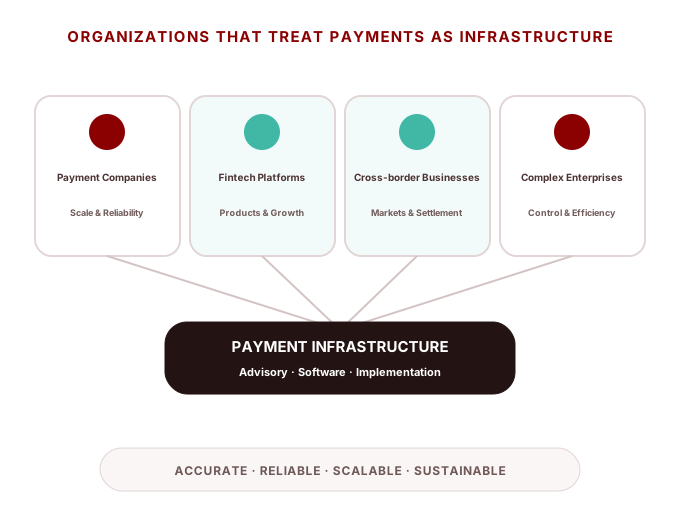
These organizations have typically moved beyond basic payment API integration and now need to manage transactions, accounts, funds, ledger, reconciliation, settlement, vendors, operations and system scaling as one connected infrastructure problem.
We do not define fit by industry breadth. We focus on organizations where payments have become a core business capability, critical operating capability or strategic infrastructure.
Payment infrastructure directly affects transaction quality, fund safety, product capability and the ability to scale. This includes businesses managing multiple providers, products, ledgers and settlement processes.
As wallets, cards, remittance and other products grow, teams need shared transaction, account, funds and operating capabilities so infrastructure maturity keeps pace with product growth.
Multiple markets, currencies, FX, payout channels and settlement relationships quickly increase infrastructure complexity and require consistent workflows, funds facts and operating controls.
When payments involve multiple providers, corporate cards, global payouts, fund allocation, fees and complex reconciliation, payments become critical operating infrastructure rather than a back-office function.
REALSUCC tends to create more value after an organization moves beyond simple payment integration into multi-product, multi-provider, multi-market and scaled operations.
You need unified integration, routing, vendor management and exception handling.
Wallet, card, remittance and other products begin to require shared payment capabilities.
Currencies, FX, banks and local payment methods multiply.
Reconciliation, exceptions, settlement and vendor operations can no longer depend on manual work.
Technical debt, coupling and change cost begin to slow growth.
Leadership starts to manage quality, risk, funds accuracy and long-term operability systematically.
Company size alone is not the deciding factor. Payment complexity, funds risk and infrastructure quality matter more.
You already connect multiple payment providers or banks and are managing multiple accounts, currencies, markets or products.
Ledger, reconciliation, settlement, exceptions and funds operations are becoming harder and more manual.
You are expanding products or markets and now care about architecture, quality, governance and sustainable operations—not only speed to launch.
Strategy, growth capacity, risk exposure and investment priorities.
Product capabilities, workflows, payment experience and market expansion.
Exceptions, providers, funds operations and scale efficiency.
Balances, ledger, reconciliation, fees and settlement accuracy.
Reliability, scalability, technical debt, system boundaries and modernization.
If your payment business is becoming more complex across products, providers, markets, funds or ledger, start with a structured discussion or payment infrastructure assessment.