
What does high-quality payment infrastructure mean?
HQPI is REALSUCC’s framework for defining and assessing high-quality payment infrastructure. It moves beyond “the system works” to evaluate funds accuracy, transaction reliability, resilience, security, scalability, operability and sustainability.
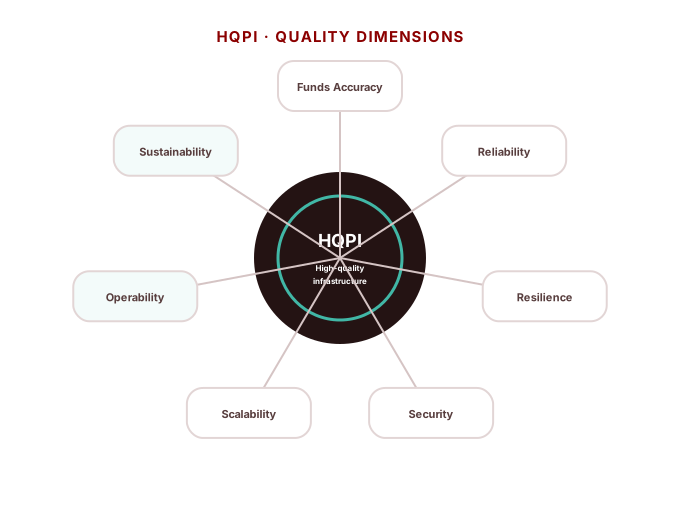
Why a payment quality framework is needed
Going live does not mean the infrastructure is high quality. HQPI creates a shared quality language so business, product, technology, operations and management can evaluate the same target state.
Core framework
Funds & ledger accuracy
Can funds, balances, entries, fees and settlement be explained, reconciled and traced?
Transaction reliability
Are outcomes deterministic, failures recoverable and reversals complete?
Stability & availability
Can services remain available and recover quickly under peaks, faults and dependency failures?
Security & risk controls
Are identity, access, keys, sensitive data, fraud and critical actions controlled?
Performance & scalability
Can volume, products, markets, currencies and providers grow with controlled risk?
Operations & observability
Can issues be detected, diagnosed, resolved, reviewed and converted into improvement?
Product & technical sustainability
Can delivery speed, testing, documentation, versions and technical debt be governed over time?
Economic & business efficiency
Do quality investment, provider cost and operating complexity align with business value and risk?
How HQPI is used
Establish the quality baseline
Use eight quality dimensions to define scope and required evidence.
Identify quality gaps
Separate critical risks, structural weaknesses and longer-term improvements.
Define the target state
Set quality targets appropriate to business stage and risk rather than abstract “best practice”.
Build an improvement path
Translate gaps into architecture, software, operations and governance actions.
Typical outputs
Quality profile
A structured view of the current state across eight dimensions.
Key risks and evidence
Evidence-based findings affecting funds, transactions and production operations.
Priority improvements
Sequenced actions based on risk, business value and dependencies.
Quality target and reassessment baseline
A baseline for implementation and ongoing governance.
The four methods are designed to work together rather than as isolated frameworks.
Start with a quality baseline
Use HQPI to structure an evidence-based assessment of your current payment infrastructure quality.