
Ledger & Balance Mismatch
When customer balances, internal ledgers, PSP records and bank funds do not reconcile consistently, the issue is rarely a single bad record. It usually points to breaks in the funds model, ledger rules or processing lifecycle.
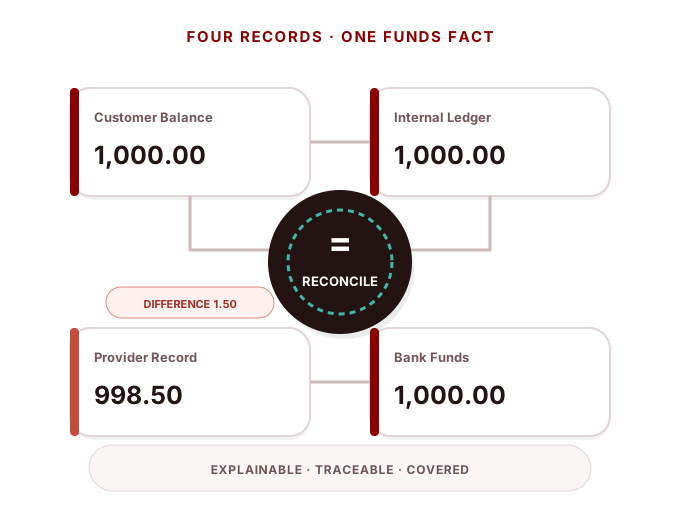
What you may be seeing
- Teams repeatedly explain balance movements by hand.
- Internal ledger balances differ from PSP, bank or settlement records.
- Refunds, chargebacks, fees or manual adjustments frequently create unexplained balances.
- Month-end close requires repeated manual postings and investigations.
- The same funds have different amounts, owners or statuses across systems.
Why it happens
Ledger, business balance and accounting boundaries are unclear.
Posting rules and balance constraints are incomplete.
Transaction state and posting time are misaligned.
Refund, chargeback, fee and reversal models are incomplete.
Manual adjustments lack complete rationale and audit evidence.
Systems do not share stable funds identifiers.
Where the issue usually sits
Business & Funds
Where the business outcome and money state become inconsistent.
Systems & Data
Where identifiers, state, rules or data diverge across systems.
External Dependencies
Where providers, banks or networks add different semantics.
Controls & Operations
Where exceptions, ownership and evidence fail to close the loop.
What happens if it persists
- Funds risk and customer impact can grow before the issue is visible.
- Manual investigation and operational cost increase over time.
- Close, audit and management reporting become harder to trust.
- Scale amplifies the underlying structural problem.
When this is no longer a one-off balance discrepancy
If unexplained balances, recurring adjustments or breaks between subledgers and external funds persist, the issue is usually structural rather than an isolated data error.
- Can the team explain the issue without relying on one key person?
- Can every affected transaction or funds movement be traced end to end?
- Are exceptions classified, owned and closed with evidence?
- Do rules work consistently across providers and markets?
- Is the same issue recurring despite repeated manual fixes?
How balance accuracy problems typically escalate
This ladder is not a score. It is a diagnostic continuum that helps distinguish an isolated discrepancy from a structural loss of confidence in the funds truth layer.
Isolated discrepancy
A small number of differences can be traced to a specific transaction, timing event or data defect and closed without changing the underlying model.
Recurring adjustment
The same categories of differences reappear and teams begin using manual adjustments or spreadsheets as a normal operating step.
Close becomes dependent on manual work
Month-end or daily close requires repeated reconciliation, explanation and adjustment across accounts, providers or settlement records.
Balances cannot be reliably reconstructed
Teams cannot consistently rebuild an account balance from business events, ledger entries and external funds evidence.
Funds truth is no longer trusted
Management, finance or operations cannot rely on balances and subledgers as an authoritative representation of customer and company funds.
When recurring adjustments become part of normal operations, or when a balance cannot be reconstructed end to end from evidence, the issue should be treated as a structural accounting and funds-control problem rather than a data-cleanup task.
How to address it
Structure the symptom
Separate visible symptoms from underlying causes.
Build a fact baseline
Use transaction, funds, system and operational evidence.
Fix the model, not only the data
Correct structural rules before cleaning historical records.
Close the control loop
Give each exception ownership, action, verification and closure.
Measure recurrence
Use repeated issues to drive product, architecture and operational improvement.
Move from the problem to the right solution
Ledger, Reconciliation & Settlement
Explore the relevant solution and delivery path.
Explore solution →Payment Infrastructure Assessment
Explore the relevant solution and delivery path.
Explore solution →Payment Architecture & Modernization
Explore the relevant solution and delivery path.
Explore solution →Common questions
Is the visible symptom always the root cause?
No. Payment problems often surface in reconciliation, balances or operations while the underlying cause sits in state, ledger, data or architecture.
Should we fix historical data first?
Usually establish the model and control baseline first, then remediate historical data without recreating the same issue.
Where should an investigation start?
Start with evidence: transaction lifecycle, funds movement, ledger entries, provider records, operational workflow and recent incidents.
Start from the real problem
Structure the symptom, root cause, impact and current controls before choosing the remediation path.