
Payment Infrastructure & System Assessment
Assess payment infrastructure and system quality with evidence rather than assumptions. Through a structured review of business flows, funds, ledger, transactions, systems, data, operations and controls, REALSUCC identifies critical risks, quality gaps and the issues that deserve priority.
Page scope: This is an end-to-end solution for a business and infrastructure problem, not a single software product. An engagement may combine advisory, architecture, software, implementation and governance.
When an assessment is useful
When payment infrastructure begins to affect financial accuracy, operational efficiency, system evolution or the next stage of growth, an independent structured assessment creates a shared fact base and clear priorities.
Quality and risk are hard to judge
The system runs, but management lacks an objective view of financial, transaction, system and operational quality.
Teams disagree on root causes
Business, product, technology, operations and finance hold different views, making priorities difficult to align.
Problems keep returning
Ledger breaks, transaction exceptions, operational issues and technical debt recur while remediation remains local and reactive.
Expansion is approaching
A new market, product or higher transaction scale requires confidence that the current infrastructure can support growth safely.
A rebuild, migration or purchase is planned
A major system decision needs an independent and structured baseline before investment begins.
A major incident has occurred
A material outage, financial discrepancy or persistent operational issue requires systematic root-cause analysis and prevention.
Key quality dimensions across the payment business and system
The assessment is not limited to technical architecture. It covers business processes, funds and ledger, transaction processing, system architecture, operating controls and governance.
Business model, participants, payment journeys, providers and critical dependencies.
Funds flow, accounts, balances, ledger, fees, reconciliation and settlement.
States, timeouts, retries, idempotency, reversals, compensation and recovery.
System boundaries, domains, interfaces, dependencies, technical debt and scalability.
Availability, recovery, performance, capacity, resilience and key dependencies.
Access, permissions, sensitive data, auditability and critical business controls.
Manual work, exceptions, refunds, disputes, provider incidents and operational closure.
Logs, metrics, traces, alerts, data quality and operational visibility.
A consistent method grounded in verifiable evidence
REALSUCC combines expert judgment with business facts, system materials, operational data and production evidence, using a consistent methodology to reach assessment conclusions.
High-Quality Payment Infrastructure Framework
Defines the core quality dimensions and standards covered by the assessment.
Payment Infrastructure Maturity Model
Assesses current maturity and identifies priority capabilities for the next stage.
Payment Architecture Review Standard
Reviews architecture quality across funds, transactions, reliability, security and scalability.
Payment Quality Gate
Tests whether clear quality conditions exist across requirements, design, build, testing, launch and operations.
Typical evidence used in the assessment
- Business processes and operating procedures
- Product and system architecture materials
- Interfaces and data models
- Ledger, reconciliation and settlement data
- Transaction and exception data
- Operational metrics, logs and alerts
- Testing, incident and postmortem records
- Provider materials and stakeholder interviews
How the assessment is conducted
The work moves from scope and evidence to analysis, scoring, prioritization and an executive-level improvement roadmap.
Define Scope
Confirm the business scope, priority questions, participating teams, system boundaries and objectives.
Collect Evidence
Gather relevant business, system, data, funds, operational, incident and control materials.
Analyze & Validate
Use interviews, data analysis, process checks and system reviews to validate issues and root causes.
Score & Prioritize
Assess maturity, risk and quality gaps, then determine improvement priorities.
Report & Roadmap
Present key findings to management and relevant teams and define the next-stage roadmap.
What the assessment delivers
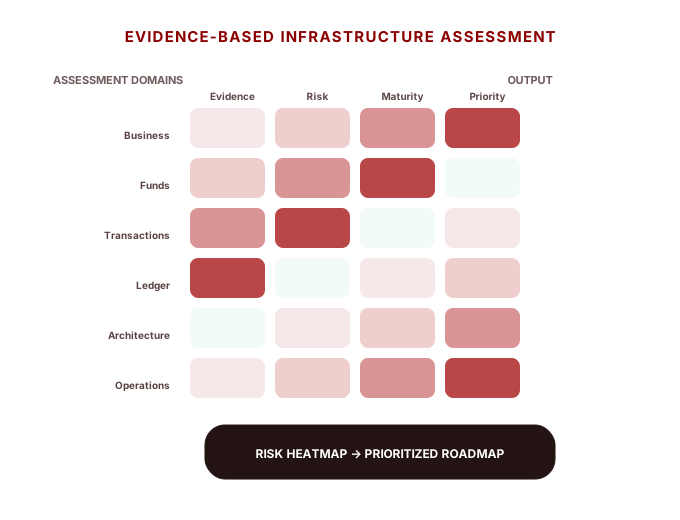
The goal is not another report. It is an explainable, decision-ready and actionable baseline for the payment infrastructure.
Current-State Assessment
A structured view of the current business, funds, ledger, transactions, systems and operations.
Infrastructure Landscape
A visual map of payment flows, system dependencies, funds movement and key controls.
Maturity & Quality Scoring
A consistent assessment of maturity and critical quality dimensions.
Risk & Issue Register
Issues, root causes, impact, severity and accountable domains.
Priority Matrix
Immediate fixes, short-term remediation, medium-term build and long-term evolution.
Target-State Recommendations
The capabilities, controls and quality outcomes the organization should reach.
Improvement Roadmap
A staged 90-day, six-month and twelve-month action plan.
Executive Readout
A management-level view that translates complex technical and operational issues into investment decisions.
Decisions the assessment can support
A shared fact base on risk and priority helps management direct limited resources toward the problems that matter most.
- Create a shared view of current quality, risk and maturity across payment infrastructure and systems.
- Separate symptoms from root causes, business impact and true remediation priorities.
- Reduce the risk of misdirected engineering investment, software procurement and ineffective remediation.
- Establish scope and quality baselines for architecture change, software build, migration, procurement or targeted remediation.
- Prioritize annual technology and operations investment.
- Judge whether the infrastructure can support new markets, products or higher transaction scale.
What can follow the assessment
Based on the findings, the next stage may involve architecture modernization, targeted remediation, software implementation or continuous governance.
Payment Architecture & Modernization
Modernize core architecture, system boundaries and structural technical debt.
Ledger, Reconciliation & Settlement
Improve financial accuracy, ledger, reconciliation and settlement capabilities.
Payment Operations & Controls
Strengthen exception handling, provider management, funds operations and day-to-day controls.
Start with the real problem
If you need an objective view of current payment infrastructure quality, critical risks and next-stage investment priorities, start with a structured assessment.