
Payment Operations & Controls
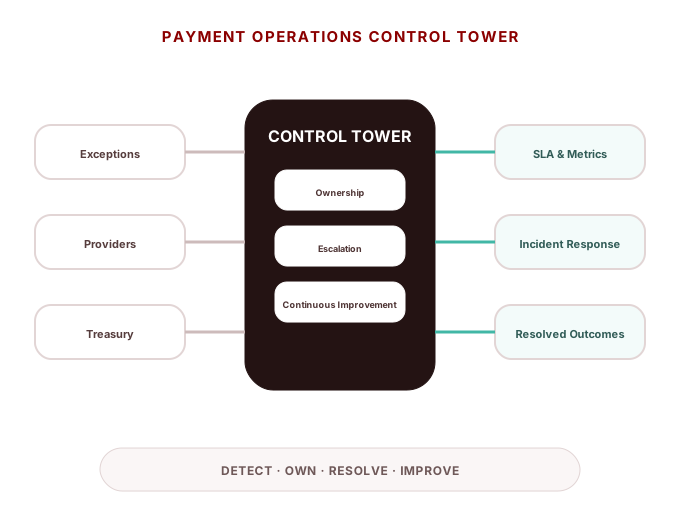
Payment operations determine whether payment infrastructure can run reliably over time. REALSUCC helps organizations establish exception handling, payment provider governance, treasury operations, incident response and day-to-day controls so issues are detected, owned, resolved and continuously improved.
Page scope: This is an end-to-end solution for a business and infrastructure problem, not a single software product. An engagement may combine advisory, architecture, software, implementation and governance.
When payment operations and controls need to be strengthened
A large share of payment operations still depends on email, chat, spreadsheets and individual experience, making processes difficult to standardize and trace.
Transaction, funds, reconciliation and settlement exceptions lack consistent classification, priority, ownership, resolution targets and closure criteria.
Payment provider outages, balances, settlements, service levels and escalation are managed inconsistently across teams.
Prefunding, provider balances, liquidity positions and fund movements rely heavily on manual judgment without clear thresholds, rules or alerts.
Technology, operations, finance and risk teams each hold partial data, but there is no unified view of payment operational quality.
As transaction volume, providers, markets and products grow, headcount and manual workload rise at a similar pace, limiting scalability.
What payment operations & controls include
Payment operations is not customer support. It is the operating control system that connects transactions, funds, providers, incidents, exceptions and management accountability.
Exception & case management
Identify, classify, assign, resolve and close transaction, funds, reconciliation, settlement and provider exceptions through a unified workflow.
Payment provider governance
Continuously manage service levels, success rates, outages, balances, settlement, cost and escalation across providers.
Treasury & liquidity operations
Manage provider balances, prefunding, liquidity positions, thresholds, funding movements and liquidity risk.
Incident & problem management
Establish incident response, escalation, root-cause analysis and corrective-action mechanisms.
Operational metrics & observability
Use shared metrics, dashboards, alerts and trends to identify deterioration in payment quality.
Standard processes & control ownership
Define operating procedures, responsibilities, approvals, reviews, evidence and governance cadence.
Governance scope
REALSUCC connects operating processes, funds, providers, controls and quality data into one management system rather than treating them as isolated operational tasks.
Operating governance model
Define target operating model, governance boundaries, decision rights and control principles.
Exception, reconciliation & settlement workflows
Standardize how operational issues move from detection through assignment, resolution, validation and closure.
Provider performance & service-level governance
Establish provider quality metrics, service levels, scorecards, escalation and review mechanisms.
Funds, balances & liquidity controls
Define balance thresholds, alerts, funding rules, approvals and liquidity safeguards.
Incident response, escalation & root cause
Create structured incident handling, escalation paths, post-incident review and corrective actions.
Operational metrics, monitoring & quality dashboards
Create shared operational measures, thresholds, alerts and management views.
Processes, responsibilities & control framework
Define SOPs, RACI, control matrices, evidence requirements and review cycles.
System enablement & continuous governance
Identify where workflows, automation, monitoring and software should support long-term governance.
Design principles & methods
Exceptions belong in systems
Critical exceptions should not remain in chat, email or personal notes; they should enter traceable workflows.
Every issue needs clear ownership
Define owner, priority, resolution target, escalation path and closure criteria.
Controls should move upstream and automate
Use rules, thresholds, system validation and automated alerts wherever practical instead of relying on manual detection.
Funds operations must be auditable
Balance adjustments, fund movements, prefunding, refunds and other critical actions require permissions, approvals, records and evidence.
Providers require continuous governance
Payment providers are not one-time integrations; quality, cost, risk and service capability should be continuously reviewed.
Operational quality must be measurable
Use common metrics and trends to understand system health instead of relying mainly on intuition and complaints.
Give every exception a complete control loop
Exception management is not about creating more tickets. It connects payment status, funds facts, ownership, actions and evidence into a traceable operating loop.
Detect
Identify exceptions through transactions, ledger, reconciliation, settlement, monitoring or customer signals.
Classify
Determine whether the issue is related to transactions, funds, providers, systems, risk or operations.
Prioritize
Set severity based on funds impact, customer impact, scope and duration.
Assign
Route the issue to the accountable team and owner.
Resolve
Execute retry, compensation, refund, funds adjustment, provider escalation or technical remediation.
Validate & close
Confirm the issue, funds, customer and data states have been restored.
Review & prevent
Complete root-cause analysis and embed improvements into rules, systems, processes or monitoring.
Govern providers and funds as operational control objects
Payment operations must balance service quality, funds sufficiency, capital efficiency and operational risk rather than optimizing any one dimension in isolation.
Provider capability & quality
Track market coverage, payment methods, success rate, latency, availability and exception trends.
Provider funds & settlement
Monitor balances, prefunding, settlement cycles, settlement delays and concentration exposure.
Provider economics & service
Review transaction fees, FX, fixed charges, SLAs, incident response and issue closure.
Balance monitoring
Maintain visibility across banks, payment providers and operating accounts.
Thresholds, alerts & forecasting
Set minimum, maximum and risk thresholds and forecast funding needs using historical activity and business plans.
Funding, movement & approvals
Standardize funding movements, prefunding and replenishment with appropriate authorization, review and evidence.
Make operational quality measurable and actionable
Metrics are not for dashboards alone. The control loop is: metric → threshold → alert → owner → action → review.
Transaction quality
Success, failure, unknown status, retry and exception trends.
Funds quality
Balances, funds in transit, prefunding, exceptional funds and liquidity.
Reconciliation & settlement quality
Unmatched items, differences, aging and settlement exceptions.
Provider quality
Availability, response time, service levels and issue trends.
Operational efficiency
Exception volume, handling time, backlog, manual activity and recurring issues.
From manual operations to scalable operations
The goal is not to add operators as complexity grows, but to standardize, systemize and automate the work that can be made repeatable and controllable.
Identify manual work
Map critical operating processes, handoffs and dependencies on individual knowledge.
Standardize processes
Define classification, ownership, approvals, service targets and operating standards.
Systemize workflows
Move critical work into structured workflows, case management and operational tooling.
Automate controls
Introduce rules, thresholds, monitoring, validation and automated handling where appropriate.
Govern with data
Use metrics, trends, reviews and root-cause learning to continuously improve operating quality.
Final deliverables
Payment operations baseline
Document current workflows, manual dependencies, exceptions, funds risks and provider risks.
Payment operations control model
Define target operating model, control principles and governance boundaries.
Exception classification & handling framework
Define categories, priorities, ownership, service targets, escalation and closure standards.
Payment provider governance framework
Define service levels, quality metrics, scorecards, incidents and provider review mechanisms.
Treasury & liquidity control design
Define balances, thresholds, alerts, funding movements, approvals and liquidity controls.
SOPs & responsibility matrix
Define critical operational procedures, role ownership and control requirements.
Operational metrics & dashboard design
Define measures, thresholds, alerts and management views.
System enablement & governance roadmap
Define workflow automation, software enablement and continuous governance priorities.
What stronger payment operations & controls change
Reduce repetitive manual handling and non-standard operations, improving operational efficiency.
Create a complete loop from detection, classification and assignment through resolution, validation and review.
Improve payment provider governance, treasury operations and collaboration across business, technology, finance and risk teams.
Use common metrics, thresholds and trends to identify deterioration in transaction, funds and operating quality earlier.
Use standardization, systems and automation to support growth without increasing operational headcount at the same rate.
Reduce dependence on key individuals and improve the sustainability of day-to-day operations.
Give management a unified, explainable view of payment operational quality.
Related solutions
Payment Infrastructure & System Assessment
Systematically identify operational, funds, provider and control risks and priorities.
Ledger, Reconciliation & Settlement
Build accurate ledgers, traceable differences and closed-loop reconciliation and settlement controls.
Cross-Border Payments
Bring multi-market, provider, funds and cross-border operations into a consistent control model.
Payment Architecture & Modernization
Embed critical operational controls, exception handling and observability into payment platform architecture.
Build payment operations that scale
If exception handling, payment provider management, treasury operations or daily controls are increasingly dependent on manual work, start with an operations assessment to identify key risks, operational bottlenecks and priority improvements.