
Cross-Border Payments
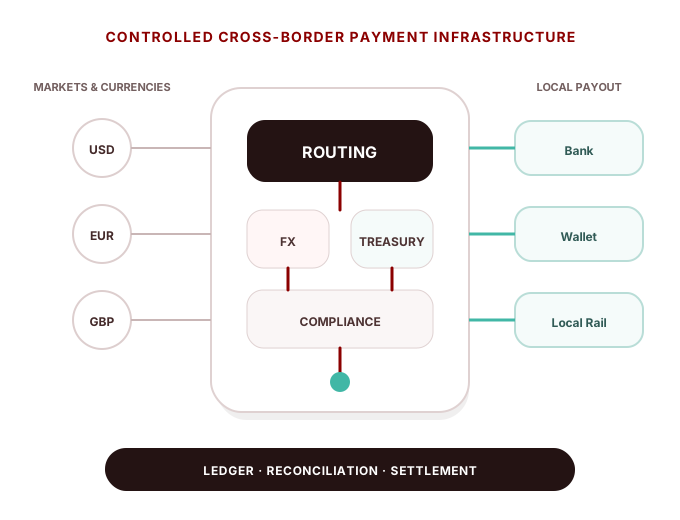
REALSUCC helps organizations design and build cross-border collections, payouts, FX, routing and settlement infrastructure that brings multiple markets, currencies, banks, payment providers and local payment methods into one controlled and scalable payment environment. The focus is on reducing fragmented provider dependencies, opaque funds and settlement states, reconciliation complexity and the operating cost of expansion.
Page scope: This is an end-to-end solution for a business and infrastructure problem, not a single software product. An engagement may combine advisory, architecture, software, implementation and governance.
When cross-border payment capabilities need to be built or upgraded
Expansion across countries requires managing different banks, payment providers, payout networks and local payment methods at the same time.
FX, provider fees, settlement cycles, collateral or prefunding begin to materially affect cost and capital efficiency.
Providers use different transaction states, failure reasons, refunds, chargebacks and exception models, increasing operational complexity.
Multiple currencies, legal entities and accounts make ledgering, reconciliation, settlement, access control and finance increasingly difficult.
Each new market requires another provider search, integration project and internal-system change, slowing expansion.
Cross-border payments are running, but management lacks a unified view of funds location, provider balances, FX cost, settlement status and exception risk.
What cross-border payment infrastructure includes
Cross-border payments are not a single rail or product. They are infrastructure that connects markets, currencies, funds networks, payment providers, ledgering and operational controls.
Global Collections & Payout Access
Connect banks, payment providers, local payment methods and payout networks through a manageable access layer.
Payment Routing & Provider Orchestration
Select appropriate paths using market, currency, payment method, cost, success rate, settlement and availability.
FX & Pricing
Manage rate sources, quotes, spreads, fees and currency-conversion rules.
Multi-Currency Accounts & Ledgering
Record accounts, balances, funds states, fees, FX and settlement outcomes consistently.
Reconciliation & Settlement
Reconcile banks, providers, internal ledgers and settlement outcomes and resolve differences.
Treasury & Liquidity Management
Manage prefunding, provider balances, positions, transfers and settlement timing.
From market access to funds operations
REALSUCC designs business, providers, funds, ledgering, routing, FX, settlement and operational controls as one system so that cross-border expansion does not become an accumulation of disconnected channels and systems.
Markets, Corridors & Payment Flows
Define target countries, corridors, customer use cases, participants, payment methods and end-to-end flows.
Payment Providers & Channel Architecture
Map banks, providers, payout networks and local methods, including capability, dependency and backup relationships.
Routing & Resilience
Design routing and failover using success rate, cost, FX, settlement, liquidity and availability criteria.
FX, Fees & Settlement Model
Define pricing, rate sources, spreads, fees, conversion logic, settlement cycles and fee treatment.
Multi-Currency Accounts & Ledgering
Standardize transaction, ledger and settlement currencies, balances, fees and accounting states.
Reconciliation & Exception Management
Create multi-layer reconciliation across transactions, ledgers, banks, providers and settlement data.
Funds, Position & Liquidity Management
Manage prefunding, provider balances, positions, transfers and liquidity risk.
Provider Governance & Operational Controls
Govern provider capability, pricing, success rates, service levels, settlement, balances, incidents and exception response.
Design principles and methods
Market Needs Before Provider Integration
Define countries, customers, currencies, funds flows and business requirements before selecting providers and methods.
Multiple Providers, One Core Model
External providers can differ while internal accounts, ledgers, transaction states and operating models remain standardized.
Standardized Core, Configurable Market Differences
Isolate country, currency, payment-method and provider variation in rules, configuration and adapters.
Funds Explainability First
At any time, the organization should be able to explain where funds are, who owns them, their state and when they can settle.
Route for Quality and Economics
Optimize not only success rates but also cost, FX, settlement time, capital usage and provider risk.
Design Reconciliation and Operations from Day One
Do not integrate first and add ledgering, reconciliation, exceptions and operating controls later.
Make every cross-border funds movement explainable
The core challenge is not only completing a transaction, but continuously and accurately explaining where funds are, who owns them, which currency they are in, what they cost and when they settle.
Funds Flows
Map customer, platform, provider and settlement funds through the full lifecycle and define responsibility boundaries.
Multi-Currency Ledgering
Separate transaction, ledger, settlement and reporting currencies while keeping accounting logic consistent.
FX & Fees
Define quotes, rate sources, spreads, fees, conversion outcomes and related gains or losses.
Settlement States
Manage pending, in-transit, settled, refunded, charged-back and exceptional funds states.
Reconciliation & Differences
Reconcile transactions, internal ledgers, banks, providers and settlement files across multiple layers.
Scale from one market to many
The goal is not to copy a new system for every country. New markets should primarily add configuration, providers and local rules while reusing standardized core payment capabilities.
Establish a Unified Core Model
Standardize accounts, ledgers, transactions, settlement, providers and operational objects.
Configure Countries and Markets
Make currencies, payment methods, limits, fees and operating rules configurable.
Standardize Provider Integration
Use common interfaces, adapters and internal state models to reduce repeated integration work.
Unify Operations and Reconciliation
Bring different markets into the same monitoring, exception, reconciliation and settlement operating model.
Expand Market by Market
Add markets, methods and providers by priority while continuously validating funds, economics and service quality.
From market assessment to production operations
Market & Business Assessment
Define target countries, customers, use cases, currencies, funds models and key constraints.
Current-State & Gap Analysis
Assess existing systems, providers, accounts, ledgers, funds and operational capabilities.
Target Solution Design
Define payment flows, provider architecture, funds flows, FX, ledgering and settlement models.
Integration & Build
Connect banks, providers and local payment networks while building required internal core capabilities.
Testing & Production Readiness
Validate transactions, funds, reconciliation, settlement, resilience, access controls and operating processes.
Launch & Continuous Governance
Continuously manage providers, cost, funds, service quality and additional markets.
Final deliverables
Cross-Border Business & Funds Blueprint
Define markets, payment methods, participants, funds flows and core business processes.
Provider & Channel Architecture
Define provider roles, coverage, dependencies, selection criteria and backup strategies.
Routing & Resilience Design
Define payment-path selection, switch conditions, recovery and degradation mechanisms.
Multi-Currency Account & Ledger Model
Standardize accounting for transactions, balances, fees, FX and settlement.
FX, Fee & Settlement Model
Define pricing, fees, currency conversion, settlement cycles and funds-treatment rules.
Reconciliation & Exception Design
Define matching and difference-handling across transactions, ledgers, banks, providers and settlement data.
Funds & Liquidity Control Model
Define prefunding, provider balances, positions, transfers and liquidity controls.
Implementation & Market Expansion Roadmap
Define provider onboarding, system build, launch and expansion into additional countries and markets.
What cross-border payment infrastructure changes
Reduce the implementation complexity of adding markets and providers through standardized core capabilities and onboarding patterns.
Reduce single-provider dependency through multi-provider architecture, routing and failover.
Improve visibility into funds location, FX cost, settlement status, provider balances and liquidity.
Bring markets, currencies and providers into a unified operating, reconciliation and exception-management model.
Build new countries, currencies, payment methods and providers on reusable infrastructure rather than isolated systems.
Give management a clearer view of cross-border payment cost, capital efficiency and provider quality.
Related solutions
Payment Infrastructure & System Assessment
Assess current systems, funds, providers and operating capability before cross-border expansion.
Payment Architecture & Modernization
Bring multi-market, multi-currency and multi-provider capabilities into a scalable payment architecture.
Ledger, Reconciliation & Settlement
Build ledger, reconciliation and settlement capabilities for cross-border funds processing.
Payment Operations & Controls
Manage providers, funds, exceptions, service levels and day-to-day operating controls.
Plan the next stage of cross-border payment capability
If you are entering new countries, adding payment providers or local payment methods, or if your existing cross-border business is already facing funds, FX, settlement, reconciliation or operating complexity, start with a structured assessment to define the target architecture, priorities and delivery path.