
Payment Orchestration System
Unify multiple payment service providers, acquirers and payment methods, with routing, failover, status normalization and rules that improve transaction reliability and payment operations.
Normalize provider interfaces, statuses and error models so business systems do not have to manage external complexity directly, while creating a common foundation for provider switching, multi-market expansion and payment strategy optimization.
Product scope: This is deployable software for a defined payment capability, not a complete advisory or business solution. It can be combined with assessment, architecture and implementation services when needed.
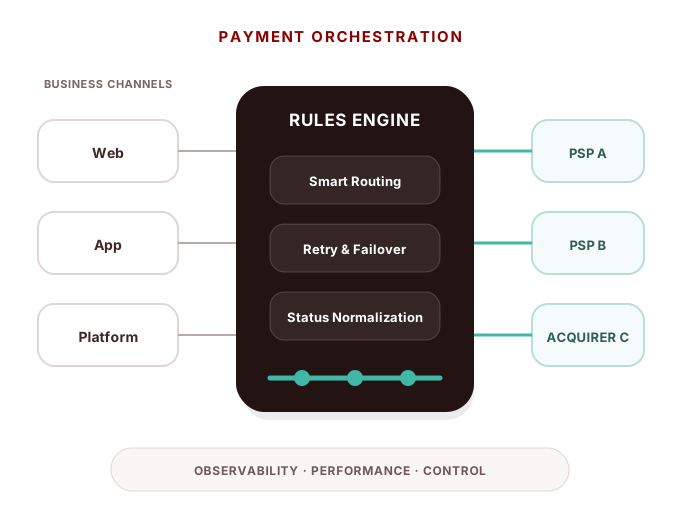
When external payment providers multiply
Repeated provider integrations
PSPs, acquirers and banks expose different APIs, fields, statuses and exception models, forcing business systems to maintain duplicated adapter logic.
Provider outages directly affect the business
Without centralized orchestration and alternative paths, provider latency, outages or partial unavailability can immediately disrupt transactions.
Routing logic is fragmented
Rules for market, currency, payment method, amount, risk, cost and provider capability are spread across systems and are hard to change consistently.
Statuses and error codes are inconsistent
The same business outcome can be represented differently by each provider, increasing complexity in operations, retries and exception handling.
Unify connectivity, routing and control
The orchestration layer centralizes provider connectivity, status normalization, routing, resilience and operational monitoring.
Unified provider connectivity
Connect PSPs, acquirers, banks and other payment channels through a standard connector framework that isolates external interface differences.
Unified Payment API
Expose a consistent payment interface to business systems and reduce direct dependency on provider-specific APIs and data structures.
Status and error normalization
Map provider statuses, failure reasons and exception results into a common internal model.
Rules-based routing
Configure payment paths using market, currency, payment method, amount, customer, risk, cost and provider capability.
Failover and degradation
Switch to alternative paths or execute degradation strategies when a provider is unavailable, times out or degrades in quality.
Retries, idempotency and recovery
Apply controlled retries, status confirmation and recovery for timeouts, unknown states and recoverable failures.
Provider strategy and governance
Manage provider capability, availability, priority, cost, service levels and fallback relationships.
Operational monitoring and analysis
Track success rates, failure reasons, latency, provider availability and routing outcomes for operations and provider management.
Normalize external providers before applying routing policy
Reference flow: Business Request → Unified Payment Intent → Provider Normalization → Routing Policy → Provider Execution → Status Normalization → Recovery & Observation.
Business Systems
Merchants, apps, wallets, issuing, remittance and other payment products.
Unified Payment API and Orchestration Layer
Normalize statuses and execute routing, failover, retries and operational monitoring.
External Payment Networks
Connect PSPs, acquirers, banks and other external payment channels.
Core objects for provider-independent orchestration
Payment Intent
A provider-neutral instruction describing what the business wants to execute.
Provider
A configured PSP, acquirer, bank or payment service endpoint.
Route
A candidate path that combines method, provider, market and commercial constraints.
Routing Policy
Rules that determine eligibility, priority, fallback and traffic allocation.
Attempt
Each execution attempt against a provider, including response, latency and reason codes.
Normalized Status
A common lifecycle model that translates heterogeneous provider states into consistent business states.
Payment routing is more than choosing the highest success rate
Effective routing balances transaction quality, economics, availability and business strategy rather than optimizing a single metric.
Success rate
Use provider, payment-method and use-case performance when defining routing strategy.
Cost
Consider transaction fees, fixed charges and other channel costs when selecting a path.
Availability
Adjust routes using provider service status, latency and outage conditions.
Market and payment method
Match providers by country, region, currency and supported payment method.
Risk and business rules
Include risk conditions, customer rules, amount limits and other business constraints.
Provider capability
Use provider product capability, limits, service levels and fallback relationships to set priorities.
Where payment orchestration fits
Multi-provider payments
A single payment business needs multiple PSPs, acquirers or banks.
Multi-market payments
Different countries and regions require different providers, currencies and local payment methods.
Payment resilience
Reduce the impact of provider outages, latency and unavailability on transaction continuity.
Routing and cost optimization
Select payment paths using success rate, cost, market and provider capability.
Legacy payment integration consolidation
Bring fragmented existing integrations into a standardized access and orchestration layer.
Fit into the existing payment stack
Place orchestration between business applications and external payment providers so routing and failover can evolve without rewriting product logic.
API First
Connect existing business systems through unified APIs, webhooks and event mechanisms.
Standard Connector Framework
Integrate PSPs, acquirers and banks through reusable connectors and adapters.
Incremental Adoption
Introduce orchestration by market, payment method or provider without migrating every existing connection at once.
Core-System Integration
Work with transaction cores, accounts, ledgers, risk, reconciliation and settlement systems, with deployment adapted to client architecture and security requirements.
Unified API
Business systems integrate once against normalized payment operations.
Provider Adapters
Each external provider is isolated behind a standard connector contract.
Routing & Failover
Policy, priority and fallback behavior can change independently from product code.
Operational Telemetry
Attempts, latency, errors and provider outcomes feed monitoring and vendor governance.
Designed for complex payment environments
Unified provider abstraction
Isolate provider-specific interfaces, statuses and error models in the orchestration and connectivity layer.
Reliability first
Build routing, failover, retries, status confirmation and recovery into the product core.
Configurable strategy
Configure routing and switching using market, cost, payment method, customer and provider capability.
Modular and composable
Use independently or combine with Payment Core, Payment Accounting and other REALSUCC payment software.
Product relationship: Payment Core manages core transaction, account and foundational money capabilities. Payment Orchestration focuses on external provider connectivity, routing, switching and provider strategy. They can be used independently or deployed together.
Unify your payment connectivity and routing
If your payment business already connects multiple providers, or is expanding into new markets and payment methods, a unified orchestration layer can reduce integration complexity, provider dependency and outage impact.