
New Payment Infrastructure
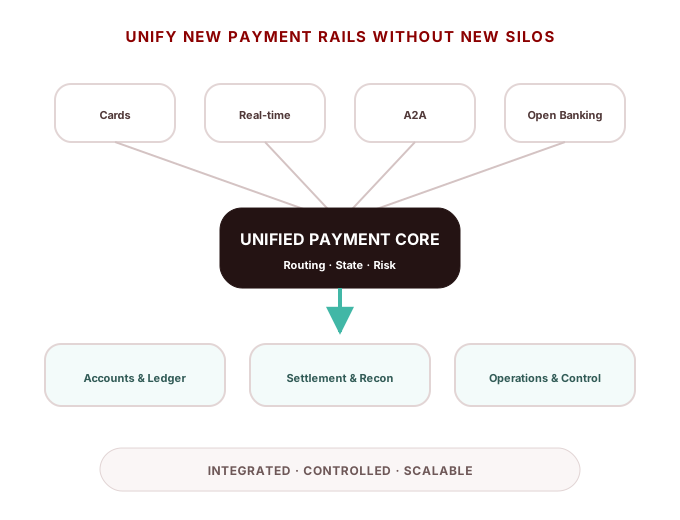
Help organizations assess, design and build real-time payments, account-to-account payments, open banking and other emerging payment capabilities, and integrate them into a unified account, ledger, settlement, risk and operations model. From business feasibility and architecture to integration, production readiness and ongoing operations, avoid turning new payment capabilities into new system silos.
Page scope: This is an end-to-end solution for a business and infrastructure problem, not a single software product. An engagement may combine advisory, architecture, software, implementation and governance.
When new payment infrastructure needs to be built
You plan to introduce real-time payments, account-to-account payments or open banking, but lack an end-to-end business model, product flow and system architecture.
New payment networks do not fit cleanly into existing account, ledger, settlement and operating models.
ISO 20022 work has been reduced to message translation without addressing data models, master data, state semantics and data quality.
Production real-time payments require 24/7 operations, liquidity management, fraud controls, exception handling and failure recovery.
Standalone pilots are creating new silos, duplicate ledger logic and long-term technical debt.
Technical connectivity is complete, but the capability has not yet become a scalable product, operating model or business.
What new payment infrastructure includes
This page focuses on payment capabilities that change how money moves, how systems connect and how operations must run, together with the data and infrastructure standards that support them.
Real-Time Payments
Use real-time or near-real-time clearing and settlement networks to support always-on or highly available funds movement.
Account-to-Account Payments (A2A)
Initiate authorization, payment and funds movement directly from bank or payment accounts.
Open Banking Payments
Connect account information, payment initiation and related financial capabilities through standardized APIs and consent.
ISO 20022 & Payment Data Modernization
Use structured, standardized payment data to improve interoperability, automation and processing quality.
End-to-end scope from business case to production operations
New payment infrastructure is more than connecting a network or API. Product, accounts, ledger, funds, data, risk and operations need to be designed together as infrastructure that can run sustainably.
Use Cases & Feasibility
Assess customer scenarios, market opportunity, funds flow, participants, regulatory constraints and commercial feasibility.
Product & Business Model
Design customer journeys, payment flows, business rules, pricing and operating models.
Accounts, Ledger & Settlement
Design accounts, transactions, ledger, balances, fees, reconciliation, clearing and settlement.
Funds Flow & Liquidity Management
Design funding, payment, clearing, settlement, position and liquidity mechanisms.
Data Model & ISO 20022
Establish business semantics, master data, transaction states, message mappings, validation rules and data-quality requirements.
Network & System Integration
Connect banks, payment networks, open-banking interfaces, payment providers and internal core systems.
Real-Time Payments & 24/7 Operations
Design always-on transaction processing, funds monitoring, liquidity, risk, exception handling and incident response.
Risk, Exceptions & Operational Controls
Build controls for fraud, exceptions, reconciliation breaks, access, auditability and operational closure.
Design principles and methods
Business use case before connectivity
Define customers, payment scenarios, funds flows and the business model before selecting networks or implementation approaches.
One account and ledger foundation
Bring new payment capabilities into a unified account, ledger and funds truth wherever possible.
Standardize the core
Standardize transaction states, accounts, ledger, reconciliation, exceptions and operational controls.
Isolate network differences
Contain bank, network and interface differences within connectivity, adapter and rules layers.
Real-time requires real-time controls
Real-time payments require real-time monitoring, risk, liquidity and exception handling—not just real-time transaction processing.
Design for production from day one
Address 24/7 operations, reconciliation, recovery, security, capacity and operational ownership during design, not after launch.
From pilot to scalable production
REALSUCC does not treat “the API works” as project completion. Business, funds, ledger, risk, operations, failure recovery and production validation are all part of the launch criteria.
Use Case & Feasibility
Confirm market, users, funds flow, payment network, economics and operating requirements.
Product & Target Architecture
Define payment flows, account model, transaction states, ledger relationships and system boundaries.
Network & System Integration
Integrate external payment networks and internal core systems securely and reliably.
Controls & Operations
Establish liquidity, fraud risk, exceptions, reconciliation, settlement and 24/7 operating controls.
Pilot & Production Validation
Validate readiness through functional, performance, failure, funds, reconciliation and operational exercises.
Scale Operations
Expand volumes and use cases gradually while monitoring success rates, risk, funds and service quality.
Final deliverables
Use Case & Feasibility Assessment
Clarify business value, suitable scenarios, key constraints and build priorities.
Target Business & Product Design
Define customer journeys, payment flows, product capabilities and operating model.
New Payment Infrastructure Architecture
Define account, transaction, ledger, data, integration, risk and operations architecture.
Payment Network Integration Design
Define how external networks, banks, open-banking APIs and internal systems connect.
ISO 20022 Data Design
Define data models, business semantics, message mappings, validation rules and testing requirements.
Funds & Operations Control Design
Define liquidity, reconciliation, exceptions, fraud risk, settlement and operational controls.
Production Readiness & Test Plan
Define functional, performance, failure, funds and operational validation criteria.
Implementation & Launch Roadmap
Define milestones from pilot and build through validation, launch and scale.
From technical connectivity to infrastructure capability
Bring new payment networks and methods into a unified account, ledger, settlement and operations model.
Reduce technology, funds and operating risk from proof of concept and pilot through production.
Avoid creating new silos, duplicated capabilities and long-term technical debt in the name of fast connectivity.
Build a sustainable foundation for transaction growth, business expansion, audit, risk controls and long-term operations.
Shorten future onboarding cycles for new payment networks, markets and product capabilities.
Improve payment-data standardization, automation and cross-system consistency.
Related solutions
Payment Architecture & Modernization
Evolve new payment capabilities together with the existing platform architecture and avoid creating new silos.
Ledger, Reconciliation & Settlement
Build the funds, ledger, reconciliation and settlement capabilities required by new payment networks.
Payment Operations & Controls
Establish 24/7 operations, exception handling, provider, risk and funds controls.
Payment Infrastructure & System Assessment
Assess current capability, gaps and build priorities before a new payment initiative begins.
Plan the next generation of payment capability
If you are evaluating real-time payments, account-to-account payments, open banking or other new payment infrastructure, start with the business use case, current systems and target capabilities to define feasibility, architecture, operating requirements and the path from pilot to production.