
Operational Complexity
As payment volume grows, the main burden is often not normal transactions but exceptions, manual checks, provider follow-up and cross-team coordination. Without systematization, operating complexity absorbs growth efficiency.
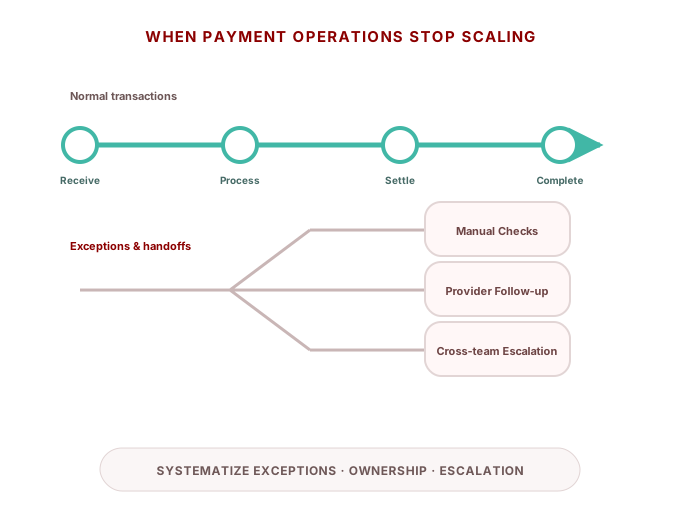
What you may be seeing
- Operational work relies on email, chat, spreadsheets and individual know-how.
- Exceptions lack common classification, priority, owner and closure criteria.
- Operators switch across many provider portals and internal systems.
- Funds, refunds, reconciliation and provider issues require repeated cross-team coordination.
- Headcount and manual workload rise with transaction volume.
Why it happens
Exceptions lack a shared object and status model.
Processes are not standardized and depend on individual judgement.
Provider, funds, reconciliation and customer issues are fragmented.
Routing, thresholds, SLAs and escalation are weak.
Operations data does not form one management view.
Incidents close without root-cause improvement.
Where the issue usually sits
Business & Funds
Where the business outcome and money state become inconsistent.
Systems & Data
Where identifiers, state, rules or data diverge across systems.
External Dependencies
Where providers, banks or networks add different semantics.
Controls & Operations
Where exceptions, ownership and evidence fail to close the loop.
What happens if it persists
- Funds risk and customer impact can grow before the issue is visible.
- Manual investigation and operational cost increase over time.
- Close, audit and management reporting become harder to trust.
- Scale amplifies the underlying structural problem.
When operational complexity can no longer be solved by adding people
If exception volume, manual handoffs, vendor coordination and operational headcount rise roughly in line with transaction growth, the operating model itself needs redesign rather than more staffing.
- Can the team explain the issue without relying on one key person?
- Can every affected transaction or funds movement be traced end to end?
- Are exceptions classified, owned and closed with evidence?
- Do rules work consistently across providers and markets?
- Is the same issue recurring despite repeated manual fixes?
How operational complexity becomes a scaling constraint
Operational complexity becomes structural when transaction growth, provider growth or product growth causes manual work and coordination effort to rise at nearly the same rate.
Manageable exceptions
A small operations team can resolve occasional exceptions with clear ownership and little cross-team coordination.
Repetitive manual work grows
The same lookups, reconciliations, provider contacts and corrections recur every day or every cycle.
Headcount begins to scale with volume
Growth in transactions, providers or products requires proportionally more operations capacity to keep service levels stable.
Handoffs and provider coordination dominate
A large share of operational effort is spent chasing status, moving cases between teams and interpreting provider-specific rules.
Operations becomes a growth and control bottleneck
The organization cannot scale new volume, markets or products without accepting higher operational risk, slower response or sharply higher cost.
Escalate from process improvement to operating-model redesign when transaction growth reliably creates proportional headcount growth, or when cross-team and provider coordination consumes more capacity than actual exception resolution.
How to address it
Structure the symptom
Separate visible symptoms from underlying causes.
Build a fact baseline
Use transaction, funds, system and operational evidence.
Fix the model, not only the data
Correct structural rules before cleaning historical records.
Close the control loop
Give each exception ownership, action, verification and closure.
Measure recurrence
Use repeated issues to drive product, architecture and operational improvement.
Move from the problem to the right solution
Common questions
Is the visible symptom always the root cause?
No. Payment problems often surface in reconciliation, balances or operations while the underlying cause sits in state, ledger, data or architecture.
Should we fix historical data first?
Usually establish the model and control baseline first, then remediate historical data without recreating the same issue.
Where should an investigation start?
Start with evidence: transaction lifecycle, funds movement, ledger entries, provider records, operational workflow and recent incidents.
Start from the real problem
Structure the symptom, root cause, impact and current controls before choosing the remediation path.