
Reconciliation Breaks
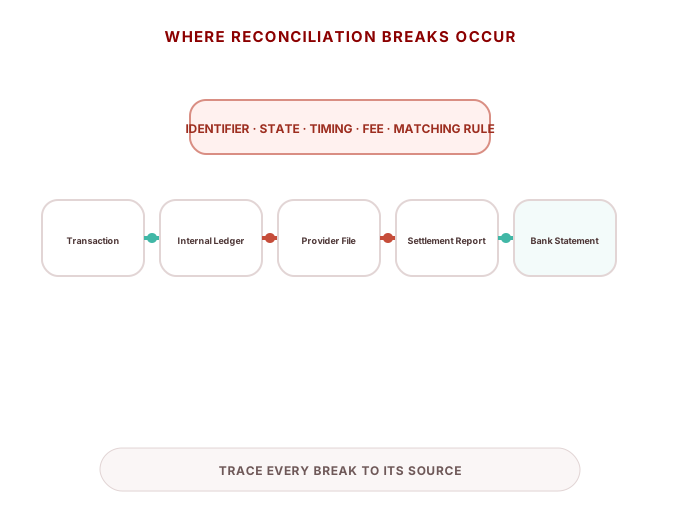
When transactions, internal ledgers, PSP files, settlement reports and bank statements do not match reliably, reconciliation breaks are often only the symptom. Root causes may sit in identifiers, state, timing, fees or matching rules.
What you may be seeing
- Large unmatched populations require daily or monthly manual review.
- The same transaction carries different amount, status or timestamp across systems.
- Fees, FX, refunds, chargebacks and cross-period events repeatedly cause breaks.
- Breaks accumulate without clear materiality or ownership.
- Reconciliation depends on spreadsheets and a few experienced people.
Why it happens
Systems lack stable common transaction identifiers.
Provider, bank, ledger and settlement data use different granularity.
State, timing and cut-off semantics are inconsistent.
Fee, FX, refund and chargeback rules are incomplete.
Matching logic is too simplistic for real payment scenarios.
Breaks lack ownership and closure workflow.
Where the issue usually sits
Business & Funds
Where the business outcome and money state become inconsistent.
Systems & Data
Where identifiers, state, rules or data diverge across systems.
External Dependencies
Where providers, banks or networks add different semantics.
Controls & Operations
Where exceptions, ownership and evidence fail to close the loop.
What happens if it persists
- Funds risk and customer impact can grow before the issue is visible.
- Manual investigation and operational cost increase over time.
- Close, audit and management reporting become harder to trust.
- Scale amplifies the underlying structural problem.
When reconciliation breaks become a structural control issue
If unmatched items accumulate across cycles, exceptions require repeated manual investigation, or the same break patterns return after each close, reconciliation is no longer a back-office clean-up task—it is a control-system problem.
- Can the team explain the issue without relying on one key person?
- Can every affected transaction or funds movement be traced end to end?
- Are exceptions classified, owned and closed with evidence?
- Do rules work consistently across providers and markets?
- Is the same issue recurring despite repeated manual fixes?
How reconciliation breaks typically become a control problem
The key question is not whether a break exists, but whether the organization can explain, own and close it consistently across cycles, providers and accounts.
Occasional unmatched item
A small number of exceptions arise from identifiable timing or reference issues and are closed quickly with evidence.
Recurring exception queue
The same break types reappear and teams maintain manual queues, spreadsheets or provider-specific workarounds.
Breaks span systems and providers
Exceptions can no longer be resolved within one system because transaction, ledger, settlement and bank records disagree.
Reconciliation delays close or settlement
Open breaks begin to affect daily close, month-end close, customer reporting, settlement release or liquidity decisions.
Internal and external funds cannot be proven to match
The organization cannot consistently demonstrate that internal records reconcile to provider, processor and bank evidence.
Escalate from exception handling to reconciliation redesign when recurring breaks survive multiple cycles, require cross-team manual interpretation, or begin to delay financial close, settlement or customer reporting.
How to address it
Structure the symptom
Separate visible symptoms from underlying causes.
Build a fact baseline
Use transaction, funds, system and operational evidence.
Fix the model, not only the data
Correct structural rules before cleaning historical records.
Close the control loop
Give each exception ownership, action, verification and closure.
Measure recurrence
Use repeated issues to drive product, architecture and operational improvement.
Move from the problem to the right solution
Common questions
Is the visible symptom always the root cause?
No. Payment problems often surface in reconciliation, balances or operations while the underlying cause sits in state, ledger, data or architecture.
Should we fix historical data first?
Usually establish the model and control baseline first, then remediate historical data without recreating the same issue.
Where should an investigation start?
Start with evidence: transaction lifecycle, funds movement, ledger entries, provider records, operational workflow and recent incidents.
Start from the real problem
Structure the symptom, root cause, impact and current controls before choosing the remediation path.