
Transaction Failures & Uncertain Status
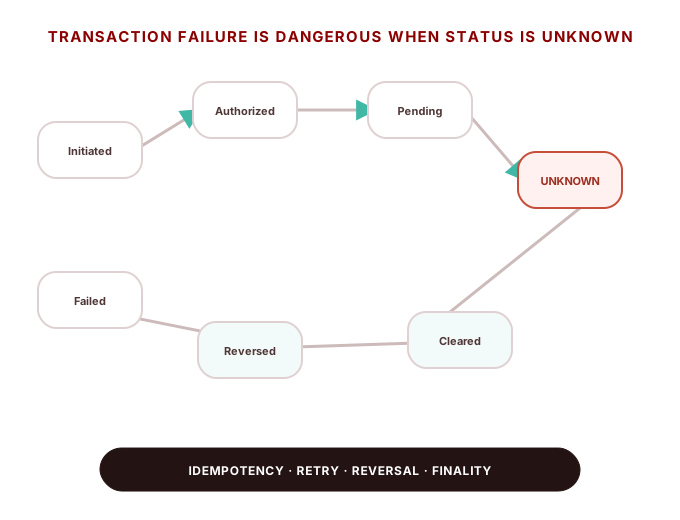
The most dangerous payment state is not failure but uncertainty about the final outcome. Unknown states can turn technical faults into duplicate charges, wrong balances, customer complaints and funds risk.
What you may be seeing
- Timeouts leave teams unsure whether the provider actually succeeded.
- Retries can create duplicate charges, payouts or business outcomes.
- Delayed, missing or out-of-order callbacks leave transactions stuck in processing.
- Reversals, voids, refunds and chargebacks are not reliably linked to the original transaction.
- Support, operations and engineering see different transaction states.
Why it happens
The transaction state machine and final states are unclear.
Idempotency, correlation and event deduplication are weak.
Timeouts trigger blind retries instead of state confirmation.
Reversal and compensation paths are incomplete.
Webhook and asynchronous event ordering is not systematically handled.
Transaction state is poorly connected to ledger and reconciliation.
Where the issue usually sits
Business & Funds
Where the business outcome and money state become inconsistent.
Systems & Data
Where identifiers, state, rules or data diverge across systems.
External Dependencies
Where providers, banks or networks add different semantics.
Controls & Operations
Where exceptions, ownership and evidence fail to close the loop.
What happens if it persists
- Funds risk and customer impact can grow before the issue is visible.
- Manual investigation and operational cost increase over time.
- Close, audit and management reporting become harder to trust.
- Scale amplifies the underlying structural problem.
When transaction exceptions begin to damage the business
If timeouts, unknown states, duplicate processing or manual recovery recur often enough to affect customers, operations or money movement, reliability must be addressed at the state-model, recovery and observability layers.
- Can the team explain the issue without relying on one key person?
- Can every affected transaction or funds movement be traced end to end?
- Are exceptions classified, owned and closed with evidence?
- Do rules work consistently across providers and markets?
- Is the same issue recurring despite repeated manual fixes?
How transaction reliability issues become a business constraint
Reliability is not only a failure-rate question. The maturity of the problem depends on whether the system can determine final state, recover safely and prevent the same failure mode from repeating.
Sporadic failures
Individual failures are visible, have a known cause and can be retried or resolved without ambiguity.
Repeated timeouts or unknown states
Timeouts, provider ambiguity or delayed callbacks create repeated transactions whose final state cannot be determined immediately.
Duplicate prevention and recovery become manual
Teams depend on manual lookup, retry, reversal or duplicate checks to close abnormal transactions safely.
Reliability incidents affect customers and revenue
Failure patterns create customer complaints, duplicate charges, abandoned payments, revenue loss or significant operational load.
Transaction finality and recovery cannot be trusted
The platform cannot consistently prove the final state of transactions or recover from partial failure without material business risk.
Escalate from incident handling to reliability redesign when unknown states or manual recovery recur across providers, or when transaction ambiguity begins to create customer, revenue, funds or operational risk.
How to address it
Structure the symptom
Separate visible symptoms from underlying causes.
Build a fact baseline
Use transaction, funds, system and operational evidence.
Fix the model, not only the data
Correct structural rules before cleaning historical records.
Close the control loop
Give each exception ownership, action, verification and closure.
Measure recurrence
Use repeated issues to drive product, architecture and operational improvement.
Move from the problem to the right solution
Payment Architecture & Modernization
Explore the relevant solution and delivery path.
Explore solution →Payment Infrastructure Assessment
Explore the relevant solution and delivery path.
Explore solution →Ledger, Reconciliation & Settlement
Explore the relevant solution and delivery path.
Explore solution →Common questions
Is the visible symptom always the root cause?
No. Payment problems often surface in reconciliation, balances or operations while the underlying cause sits in state, ledger, data or architecture.
Should we fix historical data first?
Usually establish the model and control baseline first, then remediate historical data without recreating the same issue.
Where should an investigation start?
Start with evidence: transaction lifecycle, funds movement, ledger entries, provider records, operational workflow and recent incidents.
Start from the real problem
Structure the symptom, root cause, impact and current controls before choosing the remediation path.