
Scalability & Technical Debt
The real cost of technical debt is not unattractive code; it is that every business change becomes slower, more expensive and more risky. When every new product, provider or market touches more systems, architecture is constraining growth.
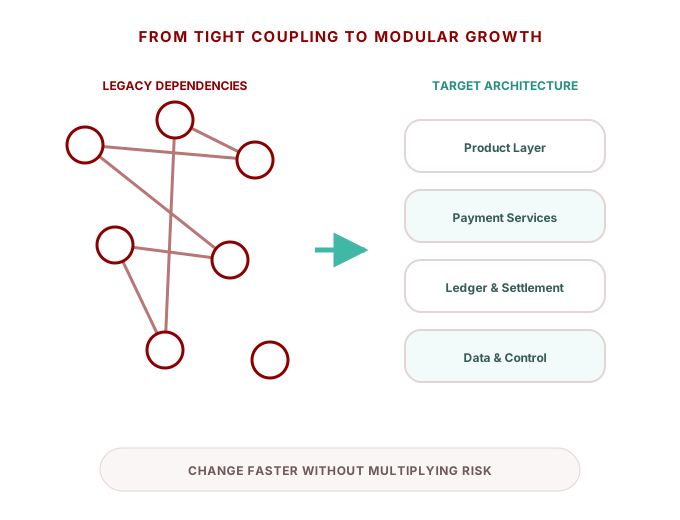
What you may be seeing
- Small changes require updates across multiple systems or databases.
- New providers, currencies or markets require copying legacy logic.
- Release cycles lengthen while regression and production risk rise.
- Critical knowledge sits with a few engineers.
- Teams know modernization is needed but short-term delivery always wins.
Why it happens
Domain boundaries are unclear.
State, rules and data models are duplicated.
Provider-specific logic leaks into the core.
Shared databases and synchronous dependencies create coupling.
Testing, observability and release governance are weak.
Structural debt is continually deferred behind feature delivery.
Where the issue usually sits
Business & Funds
Where the business outcome and money state become inconsistent.
Systems & Data
Where identifiers, state, rules or data diverge across systems.
External Dependencies
Where providers, banks or networks add different semantics.
Controls & Operations
Where exceptions, ownership and evidence fail to close the loop.
What happens if it persists
- Funds risk and customer impact can grow before the issue is visible.
- Manual investigation and operational cost increase over time.
- Close, audit and management reporting become harder to trust.
- Scale amplifies the underlying structural problem.
When technical debt becomes a constraint on growth
If each new market, product or provider requires disproportionate changes to core systems, releases become increasingly risky, or teams avoid necessary changes because of coupling, technical debt has become a business constraint.
- Can the team explain the issue without relying on one key person?
- Can every affected transaction or funds movement be traced end to end?
- Are exceptions classified, owned and closed with evidence?
- Do rules work consistently across providers and markets?
- Is the same issue recurring despite repeated manual fixes?
How technical debt turns into a business-growth constraint
Technical debt becomes strategic when change is no longer local: every new product, provider or market triggers broad regression risk, coordination cost and release uncertainty.
Local workaround
A small workaround or duplicated component solves a narrow issue without materially affecting other domains.
Repeated changes become risky
Common changes touch multiple services or code paths and regression testing expands faster than the feature itself.
New products or markets require broad rewrites
Adding a provider, currency, region or product repeatedly requires changes across transaction, funds, operations and reporting layers.
Reliability and release speed deteriorate
Release cycles slow, incidents rise and teams avoid necessary changes because dependencies are hard to predict.
Architecture constrains strategy
Business choices are rejected, delayed or made materially more expensive because the platform cannot absorb growth or change safely.
Escalate from local refactoring to architecture modernization when routine business expansion repeatedly requires cross-domain changes, release risk becomes a management concern, or architecture materially limits product and market choices.
How to address it
Structure the symptom
Separate visible symptoms from underlying causes.
Build a fact baseline
Use transaction, funds, system and operational evidence.
Fix the model, not only the data
Correct structural rules before cleaning historical records.
Close the control loop
Give each exception ownership, action, verification and closure.
Measure recurrence
Use repeated issues to drive product, architecture and operational improvement.
Move from the problem to the right solution
Common questions
Is the visible symptom always the root cause?
No. Payment problems often surface in reconciliation, balances or operations while the underlying cause sits in state, ledger, data or architecture.
Should we fix historical data first?
Usually establish the model and control baseline first, then remediate historical data without recreating the same issue.
Where should an investigation start?
Start with evidence: transaction lifecycle, funds movement, ledger entries, provider records, operational workflow and recent incidents.
Start from the real problem
Structure the symptom, root cause, impact and current controls before choosing the remediation path.